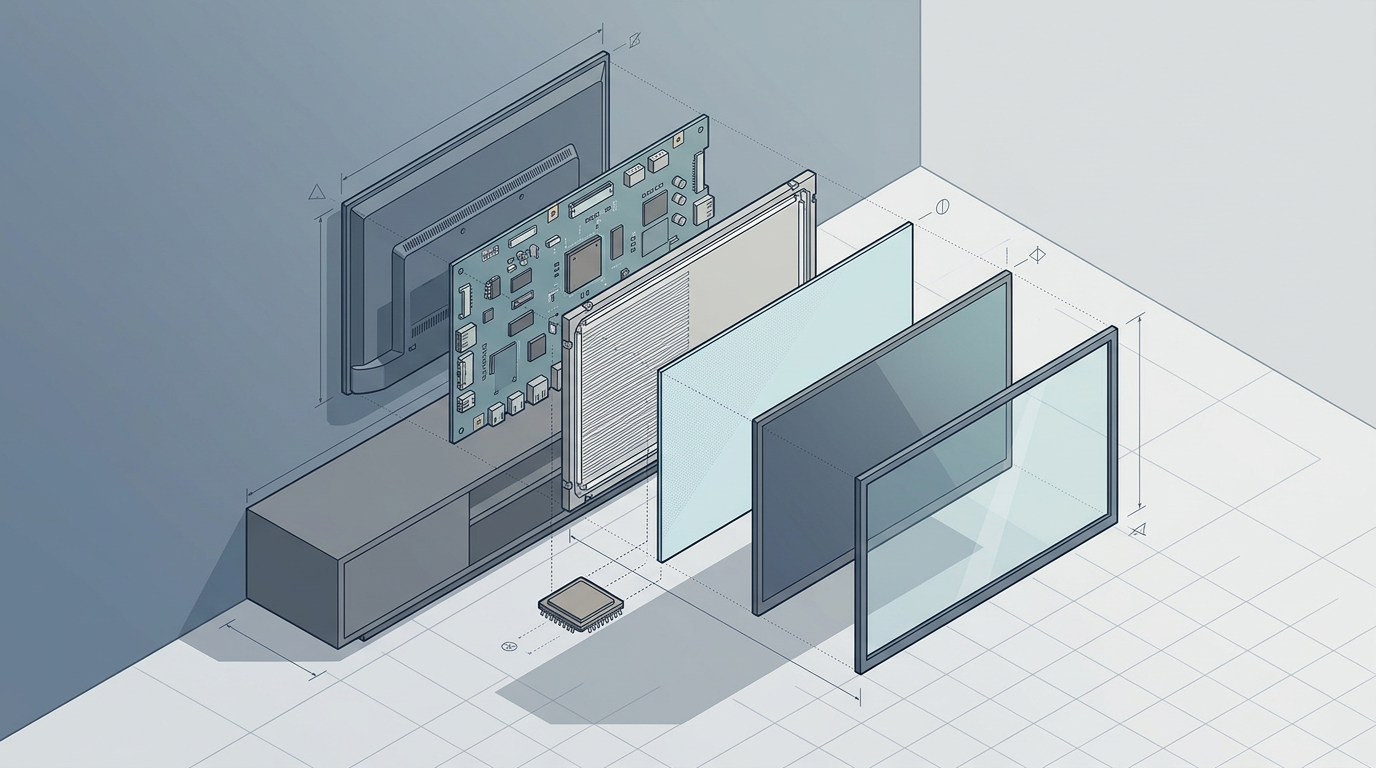
The television industry's trajectory into 2026 is defined less by raw pixel count and more by the intelligence behind the glass. Samsung's latest hardware cycle, led by the Neo QLED QN90F and the OLED S85F, signals a definitive shift toward "Vision AI" — a framework where the processor takes an active role in interpreting ambient light and acoustics to calibrate the viewing experience in real-time. TCL, meanwhile, is deploying its AiPQ processor in models like the 50P7K to bring machine-learning-driven upscaling and dynamic contrast enhancement to the mid-range segment. The pattern is consistent: the silicon inside the television is becoming as strategically important as the panel itself.
From passive panel to environmental sensor
For most of the flat-panel era, the competitive axis in consumer displays ran through resolution, color gamut, and refresh rate — specifications that could be printed on a box and compared in a spreadsheet. The shift now underway is subtler and harder to quantify. When a television uses onboard neural processing to read the ambient light in a room, adjust tone mapping frame by frame, and recalibrate audio output based on the geometry of the space, it ceases to function as a passive display. It becomes, in effect, an environmental sensor with a screen attached.
This is not an entirely new idea. Ambient light sensors have appeared in premium sets for years, and content-aware upscaling dates back at least to the early deep-learning experiments that chipmakers began integrating into system-on-chip designs in the late 2010s. What distinguishes the current generation is the degree of integration: rather than treating AI features as a marketing overlay on top of conventional image processing, manufacturers are designing their processing pipelines around neural inference from the ground up. Samsung's "Vision AI" branding reflects this architectural choice — the processor is not merely enhancing an image but making continuous decisions about how the display should behave given a set of environmental inputs.
TCL's approach with the AiPQ processor illustrates how this logic is migrating down the price ladder. By applying machine-learning models to upscale lower-resolution content and optimize contrast dynamically, the company is compressing the perceptual gap between mid-range and flagship hardware. The competitive implication is significant: if software-driven image processing can compensate for panel-level differences, the traditional premium commanded by top-tier display technology faces pressure from below.
The OLED-Mini LED tension and what it obscures
For the consumer navigating the current market, the most visible decision remains the panel technology itself. OLED delivers per-pixel dimming and the absolute blacks that have made it the reference standard for cinematic viewing. Mini LED backlighting, the foundation of Samsung's Neo QLED line, counters with higher peak brightness and, typically, a lower price per inch of screen. Each technology carries well-documented trade-offs: OLED's susceptibility to burn-in over time versus Mini LED's blooming artifacts in high-contrast scenes.
Yet this familiar debate risks obscuring the more consequential development. As onboard processing grows more capable, the raw characteristics of the panel become one variable among several. A sufficiently intelligent processor can mitigate blooming through localized dimming algorithms or extend the effective lifespan of OLED subpixels through predictive wear-leveling. The question shifts from "which panel is better" to "which system — panel plus processor plus software — produces the best result in a given room, for a given type of content."
The addition of gesture controls and voice-integrated AI assistants extends this logic beyond image quality into interface design. The television is absorbing functions that once required separate devices or manual adjustment, positioning itself as the primary computational surface in the living room.
Where this trajectory leads depends on forces that remain in tension. Deeper AI integration demands more powerful — and more expensive — onboard silicon, which could offset the cost savings that mid-range manufacturers are trying to deliver. Privacy considerations around always-listening, always-sensing devices in domestic spaces have yet to produce a regulatory consensus in most markets. And the extent to which consumers actually perceive and value AI-driven calibration over static, well-tuned image processing is an empirical question the industry has not yet answered convincingly. The television may be becoming a computer, but whether the living room wants a computer — rather than a screen — remains an open question.
With reporting from Olhar Digital.
Source · Olhar Digital