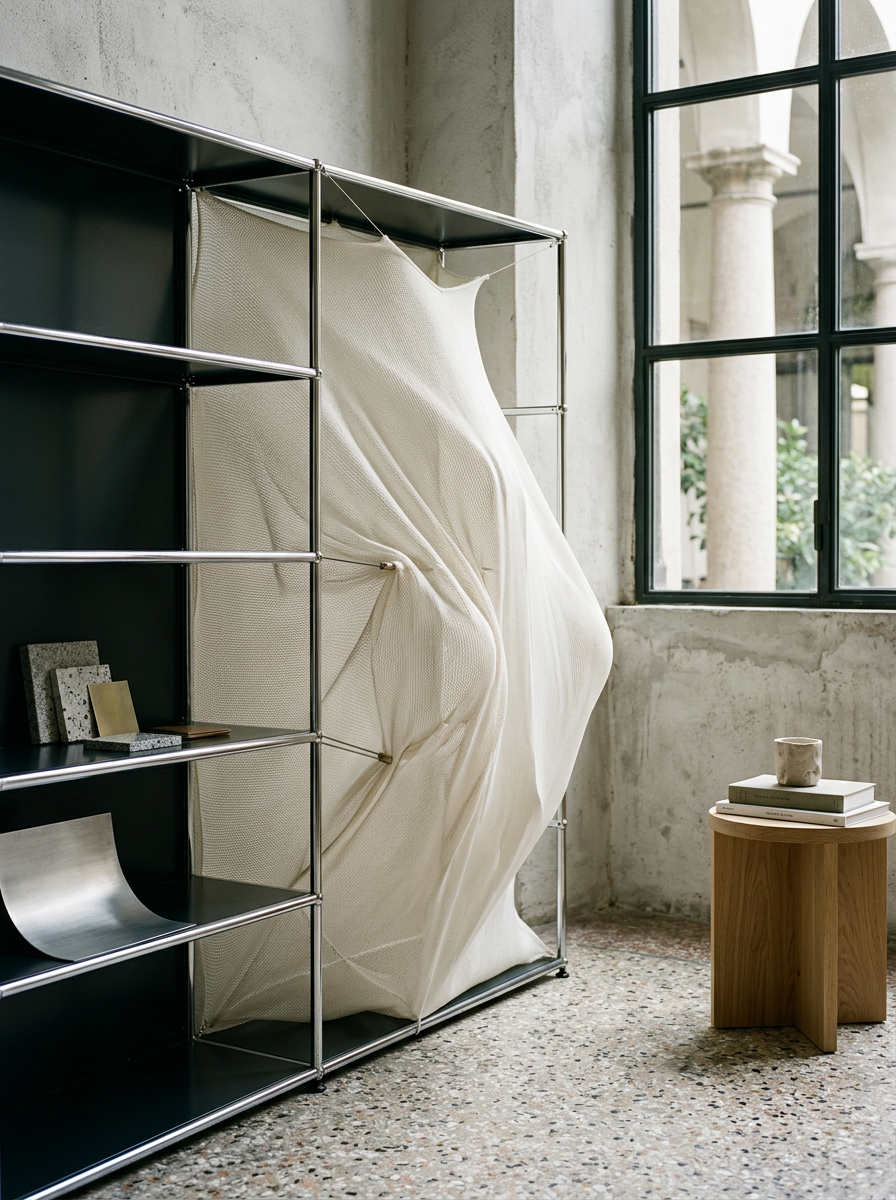
In the garden of Milan's Fondazione Luigi Rovati, a dialogue between rigidity and fluidity has taken physical form. For Milan Design Week 2026, the architecture firm Snøhetta and USM Modular Furniture have unveiled "Renaissance of the Real," an installation that repurposes the familiar logic of office modularity into a surreal, site-specific landscape. The project utilizes the USM Haller system — a decades-old benchmark of industrial precision — not as storage, but as a skeletal infrastructure that organizes the movement of both light and visitors.
The installation's power lies in a deliberate material friction. USM's iconic steel grid, finished in muted green panels, extends across the lawn in a series of low platforms and open frameworks. This permeable scaffold provides a sharp, geometric counterpoint to Snøhetta's intervention: a massive, white textile membrane that swells and compresses within the grid. The resulting form appears to "ooze" through the steel apertures, creating a soft, organic volume held in place by the uncompromising lines of the metal system.
Furniture as Infrastructure
The USM Haller system occupies a particular position in the history of industrial design. Developed in the late 1960s by the Swiss engineer Fritz Haller, it reduced furniture to a set of chrome ball joints and tubular steel connectors, allowing users to assemble shelving, desks, and storage in virtually any configuration. The system became a fixture of corporate offices and modernist interiors, its appeal rooted in the promise that a single structural grammar could accommodate infinite spatial needs. Over the decades, USM Haller has functioned less as a product line and more as a design language — one that treats the grid not as a constraint but as a generative framework.
Snøhetta's decision to treat this system as architecture rather than furniture is not without precedent in the broader design world. Milan Design Week has long served as a venue where manufacturers and designers push functional objects beyond their intended purpose, using the Salone del Mobile and its network of satellite exhibitions to test ideas that sit between product design, art, and spatial practice. What distinguishes "Renaissance of the Real" is the specificity of its material confrontation. Rather than simply scaling up a furniture system, the installation introduces a second material logic — the pneumatic textile — that operates on entirely different principles. Where the steel grid is additive, modular, and rectilinear, the inflated membrane is continuous, pressure-driven, and organic. Neither system dominates; each defines the other by contrast.
The Body Between Systems
The choice to stage this confrontation in a garden rather than a gallery or showroom carries its own implications. Outdoor installations at Milan Design Week must contend with ambient light, weather, and the unpredictable movement of visitors — conditions that resist the controlled neutrality of a white-walled interior. In this setting, the steel grid reads not as office furniture but as a kind of landscape infrastructure, closer to a pergola or trellis than a filing cabinet. The textile membrane, meanwhile, takes on an almost geological quality, its swelling forms suggesting something emerging from beneath a surface.
Snøhetta, the Oslo- and New York-based firm known for projects that negotiate between built form and natural landscape, has explored similar tensions in its architectural work — structures where rigid envelopes accommodate or respond to organic forces. The collaboration with USM transposes that interest to a smaller, more intimate scale, where visitors can physically navigate the boundary between the two material systems.
By elevating the modular grid from furniture to spatial architecture, the collaboration examines the threshold between the structured and the ephemeral. The installation does not attempt to resolve the tension between its hard and soft components; instead, it frames a landscape where the body's perception is constantly shifted by the contrast of edges and curves. The question it leaves open is whether the systems designed to organize modern work and life are containers that hold form in place, or armatures that form inevitably exceeds. The steel grid and the swelling membrane each make their case. The visitor, moving between them, is left to decide which force is winning.
With reporting from Designboom.
Source · Designboom