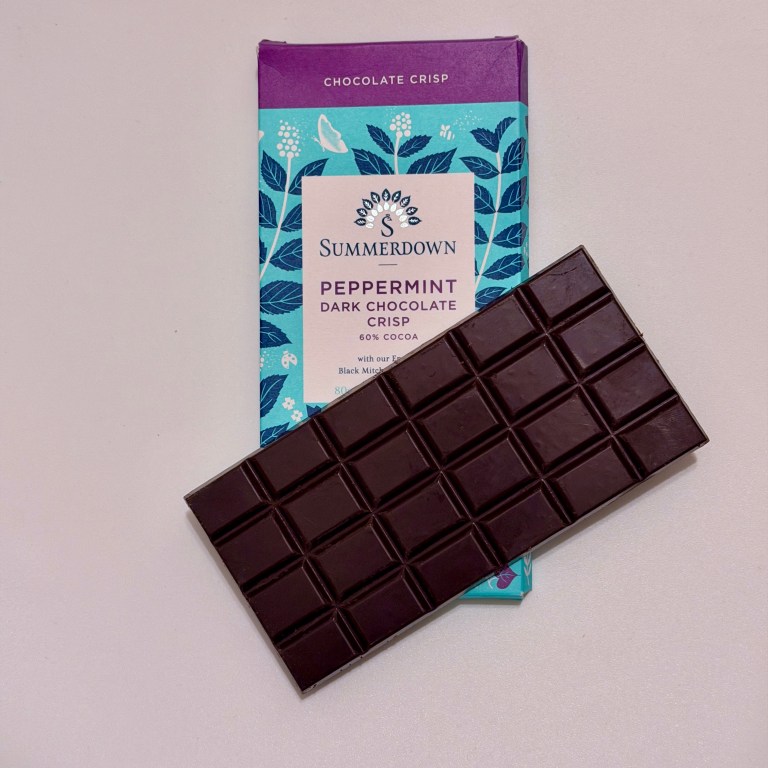
The history of flavor is, in many respects, a history of quiet extinction. Industrial agriculture has long favored yield, uniformity and disease resistance over complexity of taste — a calculus that has sidelined countless heirloom varieties across crops as diverse as wheat, tomatoes and aromatic herbs. Peppermint is no exception. Black Mitcham, once the benchmark cultivar for English mint, gradually disappeared from British fields over the course of the twentieth century, replaced by hardier strains better suited to mechanized farming. Its revival at Summerdown Farm in Hampshire, now spanning roughly three decades, represents one of the more deliberate attempts to reverse that trajectory — and its latest product, a high-cocoa dark chocolate bar, offers a useful case study in how agricultural heritage can be translated into consumer design.
The farm's effort began with a small number of cuttings sourced from abroad, the original English stock having been largely lost. Growing Black Mitcham at commercial scale is not straightforward: the variety is notably temperamental, susceptible to disease and demanding in its soil and climate requirements. That Summerdown has scaled to a dedicated estate speaks to a level of horticultural commitment that sits closer to conservation than conventional farming.
From Field to Barrel: A Process Borrowed from Fine Spirits
What distinguishes Summerdown's approach is not merely the choice of cultivar but the post-harvest treatment of the raw material. Once the peppermint is harvested, the essential oil is extracted through distillation and then barrel-aged — a step with no real precedent in mainstream confectionery production. The technique draws more from the logic of viticulture or artisan spirit-making, where time and controlled oxidation are understood to deepen and round a flavor profile. In the context of mint, barrel-aging softens the sharper menthol notes while preserving the aromatic complexity that made Black Mitcham prized in the first place.
This processing philosophy reflects a broader shift visible across specialty food and beverage: the application of craft-production principles to ingredients historically treated as commodity inputs. Single-origin chocolate, terroir-driven coffee and heritage-grain bread all follow a similar logic — the premise that provenance and process can elevate a familiar category. Summerdown's peppermint oil, in this reading, is less a flavoring additive and more an ingredient with its own narrative arc, from near-extinction to barrel to finished product.
The Bar as Object: Portable Design with Deep Roots
The Dark Chocolate Crisp Bar itself is a restrained piece of product design. It pairs 70% Colombian dark chocolate with the aged Black Mitcham oil, a combination that foregrounds the mint's clean, sharp profile against the bitterness and depth of high-cocoa chocolate. A light dusting of sugar crystals introduces a textural element — a subtle crunch that sets the bar apart from the filled-mint tradition dominant in mass-market confectionery. The effect is architectural rather than indulgent: each component serves a structural role in the overall sensory experience.
The packaging and format are designed for portability, a practical consideration that also functions as a design statement. A bar that can travel without compromising its integrity signals durability and intention — qualities that mirror the decades-long agricultural project behind it. In an era when specialty food brands compete as much on story and craft credentials as on taste, Summerdown's product carries an unusually concrete provenance claim: a specific heirloom variety, grown on a specific estate, processed through a specific and uncommon method.
The tension worth watching is whether this model — slow-growth agriculture married to premium consumer goods — can sustain itself economically at a scale beyond niche. Heirloom revival is expensive, temperamental cultivars are risky, and barrel-aging adds time and cost to a supply chain. The specialty food market rewards such commitments when consumer interest is high, but that interest is fickle. Whether Summerdown's thirty-year bet on Black Mitcham remains viable as a business, or endures primarily as a conservation project with a chocolate bar attached, may depend on forces well beyond the farm's hedgerows.
With reporting from Cool Hunting.
Source · Cool Hunting