Takashi Murakami has long operated at the intersection of high art and mass-market consumerism, a philosophy he famously termed "Superflat" — a framework that collapses the hierarchy between fine art and commercial culture, treating both as equally valid surfaces for creative expression. His independent footwear label, Ohana Hatake, continues this lineage by treating the shoe not merely as an accessory, but as a three-dimensional canvas. The upcoming Ohana Full-Bloom "Multicolor" collection marks a technical and aesthetic evolution for the brand, translating the artist's ubiquitous smiling flower motif into a functional, wearable silhouette.
The collection arrives at a moment when the boundaries between artist-led product lines and traditional fashion labels have grown increasingly porous. Where Murakami once channeled his visual language through collaborations with luxury houses — most notably his landmark partnership with Louis Vuitton in the early 2000s — Ohana Hatake represents a different proposition: full creative and commercial ownership, with no intermediary brand diluting the output.
From monochrome to multicolor
Historically, Murakami's footwear ventures have leaned toward monochromatic or restrained palettes, a choice that positioned the shoes closer to the minimalist end of the streetwear spectrum. This new collection breaks that mold, drawing direct chromatic inspiration from his iconic plush flower pillows — objects that have themselves become collectible artifacts, bridging the gap between merchandise and art object.
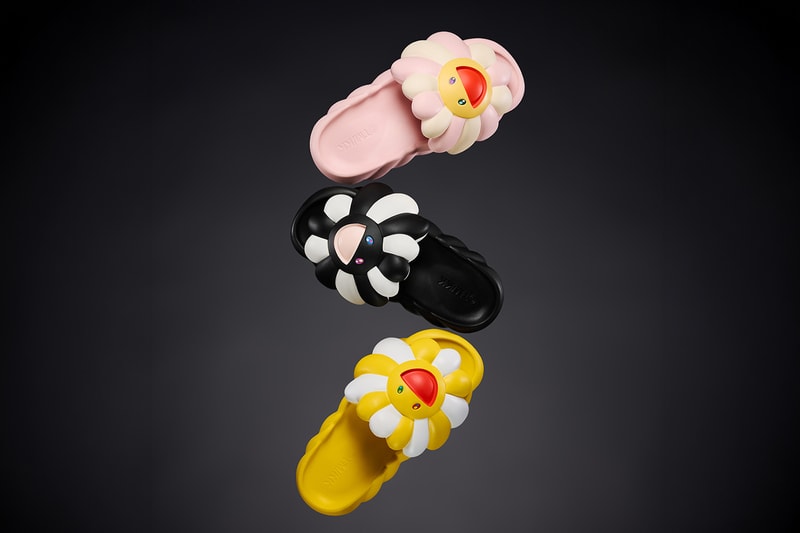
The "Multicolor" capsule offers three distinct iterations — Yellow/White/Yellow, Pink/White/Yellow, and a more somber Black/White/Black — each utilizing layered graphic combinations to create visual depth within the slip-on's structural form. The palette choices are deliberate. The brighter variants echo the saturated, almost aggressively cheerful tones that define Murakami's paintings and sculptures, while the black iteration nods to the darker undercurrents that have always run through his work, from the apocalyptic imagery of his "727" series to the skull motifs that recur across his oeuvre.
The slip-on format itself is worth noting. In a footwear market saturated with complex lacing systems, exaggerated soles, and technical overlays, the decision to build around a minimal, laceless silhouette signals a different set of priorities. The shoe functions less as a performance object and more as a wearable statement — closer in spirit to a gallery edition than a sneaker release.
Industrial design meets the gallery
Beyond the pop-art exterior, the release emphasizes refinements in material science and ergonomics. The silhouette features an upgraded EVA foam footbed designed for increased softness, paired with an enhanced traction pattern on the outsole. These are not cosmetic changes. EVA — ethylene-vinyl acetate — is a standard material in modern footwear cushioning, but its density, cell structure, and layering can vary considerably. By prioritizing these industrial improvements alongside his signature aesthetic, Murakami positions Ohana Hatake as something more than a vanity project with an artist's name attached.
This approach mirrors a broader pattern in the contemporary market, where artist-driven brands are expected to deliver on both visual identity and product quality. The era in which a famous name alone could sustain a product line has largely passed. Consumers — particularly those fluent in both streetwear culture and contemporary art — have grown sophisticated enough to distinguish between a genuine design proposition and a licensing exercise.
The collection is scheduled for an exclusive digital release on April 22, 2026. The direct-to-consumer model, bypassing traditional retail channels, reinforces the sense of controlled scarcity that has defined much of Murakami's commercial output. Whether Ohana Hatake can scale beyond limited drops into a sustained footwear operation remains an open question — one that depends as much on supply chain discipline as on artistic vision. For now, the tension between collectibility and accessibility sits at the core of the project, unresolved by design.
With reporting from Hypebeast.
Source · Hypebeast