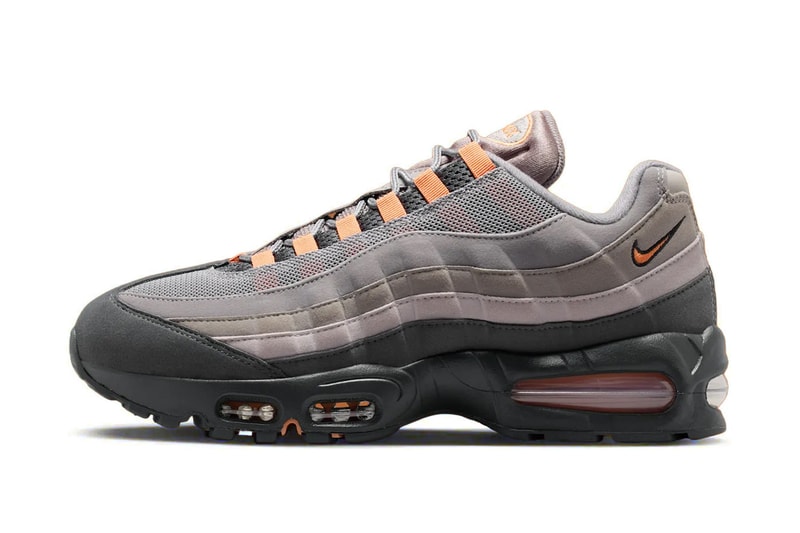
The Air Max 95 has always been a study in biological form. When Sergio Lozano first sketched the silhouette three decades ago, he drew from human anatomy — the striations of muscle, the structure of the vertebrae, the protective curvature of the rib cage. The result was one of the most architecturally distinct running shoes ever produced, a design that read more like an exoskeleton than a piece of athletic footwear. For Summer 2026, Nike is revisiting this industrial design landmark with the "Hot Curry" Big Bubble, a release that leans into the silhouette's aggressive geometry while experimenting with the physics of color.
The shoe's upper serves as a canvas for a moody, grayscale gradient. A "Pencil Point" mesh base gives way to layered suede panels that descend from light charcoal to deep anthracite, culminating in a substantial black mudguard. This monochromatic descent is interrupted by "Hot Curry" — a vibrant orange that punctuates the lace eyelets, the heel's miniature Swoosh, and the internal Air units. It is a calculated use of high-visibility accents to highlight the sneaker's technical architecture rather than obscure it. At a retail price of $190, the release is positioned squarely in the premium tier of Nike's retro catalog.
The Big Bubble and the politics of Air
The "Big Bubble" designation refers to Nike's ongoing effort to restore the larger, original specifications of its visible Air cushioning technology. When the Air Max 1 debuted in 1987, its exposed Air unit was a genuine engineering novelty — a window into the shoe's performance mechanism. Over subsequent decades, manufacturing adjustments gradually reduced the volume of visible Air in many retro releases, a change that dedicated collectors noticed and criticized. Nike's recent pivot toward restoring those original proportions represents a concession to that constituency: an acknowledgment that archival accuracy carries commercial weight.
Applied to the Air Max 95, the Big Bubble treatment carries particular significance. The original shoe featured a forefoot Air unit that was among the first to be visible in that position on a Nike runner. Restoring its scale is not merely cosmetic; it alters the shoe's proportions and, by extension, its visual identity. The Air Max 95 was never designed to be subtle, and a fuller Air window reinforces the maximalist intent of Lozano's original blueprint.
This approach fits within a broader pattern across the footwear industry. Heritage running silhouettes — from New Balance's 990 series to Asics' Gel line — have become primary vehicles for brand storytelling. The competitive logic is straightforward: a well-executed retro release leverages existing tooling and established consumer affinity while requiring less design risk than a new silhouette. The challenge lies in keeping the archive fresh without diluting it through overexposure.
Archive as living laboratory
Nike's treatment of the Air Max 95 over the past several years illustrates the tension between preservation and iteration. The silhouette has appeared in collaborations, tonal lifestyle colorways, and performance-adjacent builds. Each variation tests how far the design can stretch before it loses the qualities that made it distinctive. The "Hot Curry" takes a relatively conservative approach — the gradient structure and anatomical paneling remain faithful to the original — but the Big Bubble modification and the specific color strategy signal that Nike views even its most canonical shapes as open to calibrated revision.
The choice of a grayscale palette with a single accent color is itself a design philosophy with deep roots in sneaker culture. It foregrounds material and construction over graphic complexity, a move that tends to appeal to consumers who treat footwear as a design object rather than a fashion statement. Whether that positioning sustains the Air Max 95's relevance against a market increasingly crowded with archival runners from competing brands remains an open question — one that depends less on any single colorway than on how disciplined Nike proves in managing the silhouette's release cadence and distribution.
With reporting from Hypebeast.
Source · Hypebeast