For a decade, Edoardo Pandolfo and Francesco Palù, the founders of the Milanese studio 6:AM, have operated under a self-imposed discipline of "never saying no." The philosophy is particularly demanding given their chosen medium: Murano glass, a material whose centuries-old tradition on the Venetian lagoon island is inseparable from the physical constraints of working with molten silica. Unlike wood or metal, which permit pause and reconsideration, glass in its liquid state is governed by the physics of cooling. Once the material is hot, the clock starts — a maker has perhaps twenty minutes to execute a vision before the window of opportunity closes.
Their latest exhibition, "Over and Over and Over and Over," unveiled at the Piscina Romano during Salone del Mobile in Milan, takes that constraint and turns it into a thesis. The installation centers on the concept of repetition — not as industrial monotony, but as a meditative process. For Pandolfo and Palù, the act of redrawing and reworking a concept is a "mantra" required to find focus within a material that demands absolute certainty.
From Object to Architecture
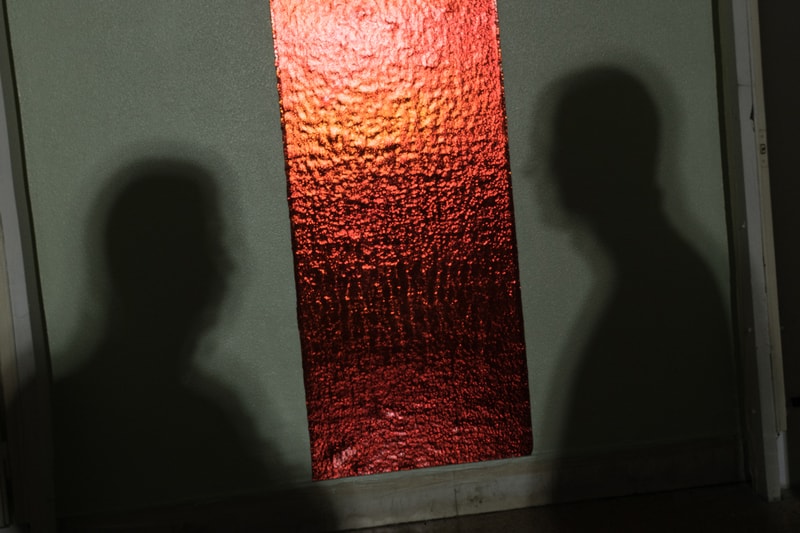
The centerpiece of the show, a towering wall of modular "Batch" glass cubes, illustrates the studio's broader ambition: to push glass beyond the realm of the decorative object and into the architectural. By stacking these glowing units into a large-scale structure, 6:AM blurs the line between furniture and building material — between the vitrine and the wall itself.
This is a meaningful provocation within a craft tradition that has long been associated with the singular, precious object. Murano glass, historically, occupies a specific register in design: chandeliers, vases, ornamental sculpture. The island's glassmaking guilds date to the late thirteenth century, when the Venetian Republic relocated furnaces from the city center to Murano partly to contain fire risk and partly to protect trade secrets. That legacy has produced extraordinary artistry, but it has also tended to confine glass within the category of decorative art. Studios working in the medium are typically evaluated on the refinement of individual pieces rather than on systemic or spatial thinking.
6:AM's modular approach challenges that framing. The "Batch" cubes function less as standalone objects and more as a vocabulary — discrete units that gain meaning through aggregation. The logic is closer to masonry or textile weaving than to traditional glass sculpture. Each cube is the product of the same exacting, time-pressured process, but the installation's impact derives from accumulation rather than singularity.
Repetition as Method
The title of the exhibition signals its conceptual core. Repetition in craft is often discussed in terms of skill acquisition — the ten-thousand-hour thesis popularized in discussions of expertise. But 6:AM frames it differently: as a design methodology in itself. Repeating a single form hundreds of times is not merely practice; it is a way of discovering what a material can become at scale.
This approach has parallels in other disciplines. In architecture, the modular concrete block transformed building in the twentieth century not through formal novelty but through the disciplined repetition of a standardized element. In ceramics, designers have explored how the humble tile — individually unremarkable — can produce complex surfaces and spatial effects when multiplied. The question 6:AM poses is whether glass, with all its thermal volatility and artisanal intensity, can operate on similar terms.
The tension is real. Scaling a handmade process is fundamentally different from scaling an industrial one. Each "Batch" cube still requires a glassblower working against the clock, still demands the physical intuition that defines Murano craftsmanship. Whether that process can sustain architectural ambitions — where consistency, structural integrity, and volume matter as much as beauty — remains an open question. The exhibition at Piscina Romano does not resolve it so much as stage the confrontation: artisanal precision on one side, architectural scale on the other, and a wall of glowing glass cubes standing at the point where the two meet.
With reporting from Hypebeast.
Source · Hypebeast