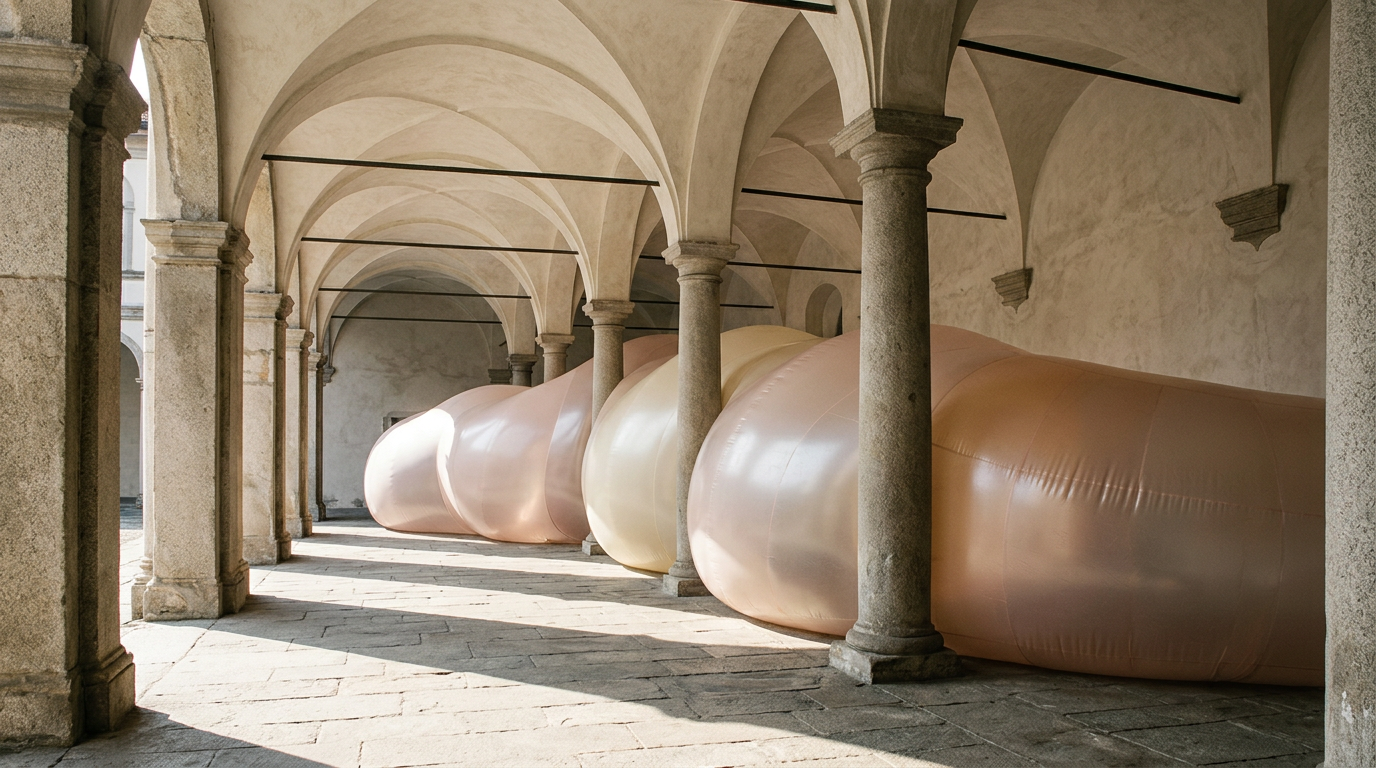
In the historic loggiato of Milan's Pinacoteca di Brera, the biochemical process of pleasure has been given a physical, breathing form. For Milan Design Week 2026, designer Sara Ricciardi introduced "Serotonin – The Chemistry of Happiness," an immersive installation that uses inflatable structures to explore how emotional states might be translated into spatial experiences. Developed in collaboration with American Express, the project occupies one of the city's most storied cultural institutions — a setting that lends the work an implicit dialogue between classical heritage and contemporary design thinking.
The installation functions as a responsive environment, where soft forms gently expand and contract in a slow choreography that mimics the rhythms of a heartbeat or human breath. By integrating light, color, and sound, Ricciardi's studio aims to provide a sensory counterpoint to the overstimulation and emotional fatigue that define much of contemporary life. The result is a space that feels less like a static object and more like a living organism.
Design as emotional infrastructure
Ricciardi's premise — that a neurotransmitter can be rendered as an atmospheric volume — sits at the intersection of two currents that have been gaining traction in design discourse for the better part of a decade. The first is the growing interest in biophilic and neuroaesthetic design, disciplines that draw on neuroscience and psychology to shape environments that actively influence mood, cognition, and physiological state. The second is the broader turn toward experiential and immersive installations at design fairs, where the object on display is not a product but a condition — a room, a sensation, an argument about how space should feel.
Milan Design Week has long served as the primary stage for this kind of proposition. The annual event, centered on the Salone del Mobile furniture fair but extending across the city through hundreds of independent installations, has evolved well beyond its trade-fair origins. Increasingly, the most discussed presentations are not showroom displays but site-specific interventions that treat architecture and atmosphere as raw material. Ricciardi's choice of the Pinacoteca di Brera — a gallery best known for its Renaissance and Baroque painting collection — reinforces the ambition: the installation does not merely occupy a venue, it recontextualizes it, placing the language of biochemistry inside a temple of art history.
Inflatable architecture itself carries a lineage worth noting. Experimental groups in the 1960s and 1970s, from Archigram in London to UFO and Superstudio in Italy, used pneumatic structures as provocations — lightweight, temporary, and deliberately anti-monumental. Ricciardi's use of the medium echoes that tradition while redirecting its purpose. Where earlier inflatable works challenged institutional rigidity, this one proposes a therapeutic function: design as a mechanism for emotional regulation rather than aesthetic disruption.
The wellness turn and its tensions
The claim that design can serve as a functional tool for well-being is not without friction. Critics of the so-called "wellness turn" in architecture and design have pointed out that framing emotional states as problems to be solved through spatial engineering risks reducing complex psychological phenomena to environmental inputs and outputs. Serotonin itself — the molecule at the center of Ricciardi's installation — has been the subject of ongoing scientific debate; its popular association with happiness is a simplification of a far more intricate neurochemical picture.
None of this necessarily diminishes the installation's value as a design proposition, but it does raise a question that the work itself seems to leave deliberately open. If the goal is to provoke an instinctive bodily response — slower breathing, a sense of calm, a momentary recalibration — does the scientific framing strengthen the experience, or does it merely lend it a veneer of authority? The boundary between genuine neuroaesthetic design and the aestheticization of science is not always clear, and the most interesting installations tend to be the ones that sit precisely on that line.
Ricciardi's work at the Brera does not resolve this tension. It stages it. A breathing room inside a painting gallery, a molecule rendered as architecture, a corporate collaboration housed in a public institution — the contradictions are part of the material. Whether the installation ultimately functions as a serious inquiry into the spatial dimensions of emotion or as an elegant piece of experiential branding may depend less on the designer's intent than on what each visitor brings through the loggiato's arches.
With reporting from Designboom.
Source · Designboom