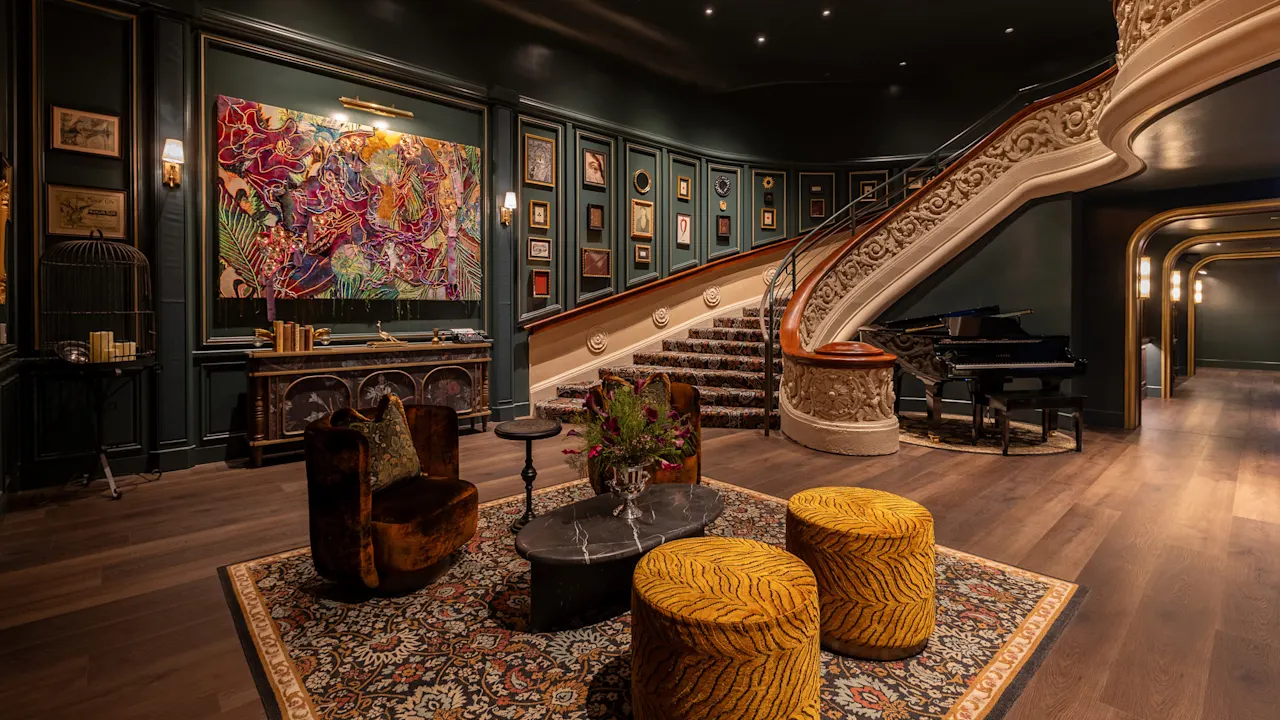
In the heart of Chicago's Michigan Avenue, the historic McCormick mansion has shed its skin as a stodgy steakhouse to become something far more ephemeral. Following a $50 million investment by venture capitalist Glen Tullman, the Gilded Age landmark has been reimagined as The Hand & The Eye, a 35,000-square-foot temple of prestidigitation that now stands as the largest magic venue in the world.
The transformation, executed by architecture firm Rockwell Group and design powerhouse Pentagram, replaces the lukewarm prime rib and white tablecloths of the building's previous tenant with a choreographed sequence of wonder. Guests entering the lobby are greeted not by a host, but by sliding wooden doors and ringing telephones — the first cues in a three-hour, no-cameras-allowed journey that moves through intimate parlors and grand theaters. It is a meticulous exercise in adaptive reuse, preserving the mansion's bones while layering in the technical infrastructure required for world-class illusion.
Designing for Disappearance
The choice of collaborators signals ambition beyond novelty. Rockwell Group, led by David Rockwell, has built a reputation on immersive theatrical environments — its portfolio spans Broadway set design, the Nobu restaurant empire, and large-scale installations that blur the line between architecture and performance. Pentagram, one of the world's most recognized independent design consultancies, brings a rigor in branding and spatial identity that few firms can match. Together, the two practices faced a distinctive brief: design a space where the architecture itself must participate in deception, guiding attention toward certain details while concealing the mechanical and structural systems that make illusions possible.
The McCormick mansion provides a fitting canvas. Built during the Gilded Age — a period already defined by the tension between surface grandeur and hidden machinery — the building carries an architectural DNA suited to spectacle. Adaptive reuse projects of this scale typically contend with the challenge of honoring historical fabric while inserting modern program. Here, the challenge is compounded: the building must not only function as a contemporary venue but must actively misdirect. Sightlines, acoustics, lighting rigs, trap mechanisms, and audience flow all require integration into a structure that was never designed to accommodate them. That the designers chose preservation over demolition suggests a conviction that the mansion's original character — its ornamental weight, its sense of enclosure — serves the illusion rather than obstructing it.
Magic as Luxury Experience
Tullman's bet is a significant one in the experience economy. At $225 per ticket, the venue positions magic as a luxury pursuit, stripping away the kitsch often associated with the craft. By banning phones, the space forces a rare, undistracted engagement with the physical world. Tullman has described it as a "100-year venture" — a permanent monument to the analog art of surprise in an increasingly digital age.
The pricing and format place The Hand & The Eye in a category alongside immersive theatrical productions such as "Sleep No More" in New York and high-end experiential dining concepts that have proliferated in major cities over the past decade. These ventures share a common thesis: that scarcity, physical presence, and sensory engagement command a premium precisely because they cannot be replicated on a screen. The no-camera policy reinforces this logic. In an attention economy saturated with content, the experience that refuses to become content acquires its own form of exclusivity.
Whether the model sustains itself over the long term depends on variables that extend beyond design. Magic, as a performing art, requires a continuous pipeline of talent willing to work within a fixed venue rather than touring. It also demands an audience base willing to return — or a tourist market deep enough to fill a 35,000-square-foot space night after night. Chicago's position as a major convention and tourism destination works in the venue's favor, but the history of large-scale entertainment venues is littered with ambitious openings that struggled to maintain momentum once the novelty faded.
What remains clear is that The Hand & The Eye represents a deliberate architectural argument: that the built environment can still compete with the screen for human attention, provided the space is designed not merely to house an experience but to become one. Whether that argument holds over Tullman's stated century-long horizon — or whether it proves to be its own kind of illusion — is a question the market will answer in time.
With reporting from Fast Company Design.
Source · Fast Company Design