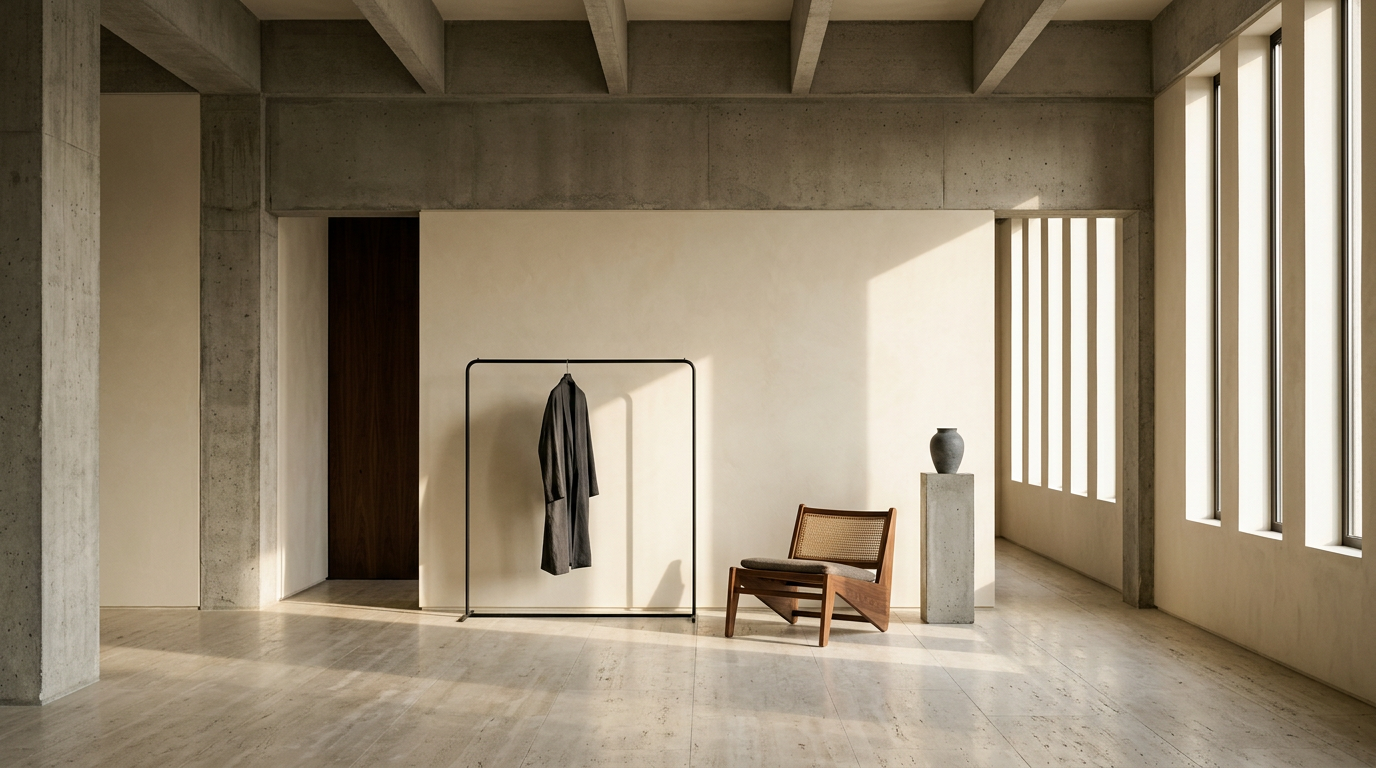
In the current landscape of collectible design, the object is often treated as a singular protagonist — isolated on a pedestal, lit from above, stripped of spatial context. SM Bureau's "Rebirth" exhibition in Paris pushes against that convention. The studio presents a series of works in wood, stone, and ceramic not as discrete artifacts but as elements of what it frames as a "spatial composition," where furniture and sculptural forms are governed by architectural logic rather than curatorial hierarchy. Proportion, alignment, and the interplay of material and light dictate the atmosphere of the room.
The exhibition follows a previous iteration staged in Brussels. This Paris chapter, however, adopts a more restrained tone, leaning further into the idea that the arrangement of objects can constitute an environment rather than merely populate one.
Material as Record
At the core of "Rebirth" is an attention to what might be called material memory — the visible traces of process that industrial finishing typically erases. Stone is cut into precise geometric planes, yet retains the raw marks of its extraction. Wood is shaped in ways that expose the irregularities of natural growth rather than sanding them away. Ceramic surfaces carry the cracks, crystallizations, and color shifts that emerge during firing.
This approach places SM Bureau within a broader current in contemporary collectible design that treats imperfection not as a defect but as information. The philosophy has deep roots. Japanese aesthetic traditions around wabi-sabi have long valued the beauty of wear and incompleteness. In European craft, the mid-twentieth-century studio pottery movement similarly resisted the uniformity of industrial ceramics. What distinguishes the contemporary iteration — visible in studios working across Milan, Antwerp, Brussels, and now Paris — is the deliberate framing of these material qualities within spatial narratives. The object is not merely handmade; it is positioned as a document of its own transformation from raw matter to refined form.
By leaving these transitions legible, "Rebirth" asks the viewer to read each piece twice: once as a functional or sculptural presence in the room, and again as a compressed timeline of geological, biological, and thermal processes.
From Object to Environment
The more consequential proposition in "Rebirth" is structural rather than material. Collectible design fairs and gallery exhibitions — from Design Miami to Salon Art + Design — have historically privileged the individual piece. A chair, a table, a vessel is presented as an autonomous work, valued for its formal qualities and the reputation of its maker. The spatial context tends to be neutral: white walls, controlled lighting, minimal interference.
SM Bureau's installation inverts that priority. The room itself becomes the work. Furniture and sculpture are positioned according to proportional relationships that recall architectural planning more than gallery curation. Light is treated not as a neutral illuminator but as an active material, shaping perception of surface, depth, and scale. The boundary between a traditional exhibition and a curated interior blurs — a move that raises questions about where design ends and architecture begins.
This is not an entirely new idea. Architects from Carlo Scarpa to Peter Zumthor have long designed exhibitions where the spatial envelope is inseparable from the objects it contains. What is notable is seeing a design studio — rather than an architect — claim that territory, suggesting that the discipline of collectible design is expanding its ambitions beyond the production of things toward the articulation of inhabited space.
Whether that ambition can sustain itself outside the controlled conditions of a gallery remains an open question. A spatial composition calibrated for a Paris exhibition operates under ideal circumstances: fixed lighting, no occupants rearranging furniture, no competing domestic clutter. The tension between the studio's architectural aspirations and the realities of lived interiors — where objects inevitably lose their choreographed relationships — is precisely the friction that makes the proposition worth watching.
With reporting from Designboom.
Source · Designboom