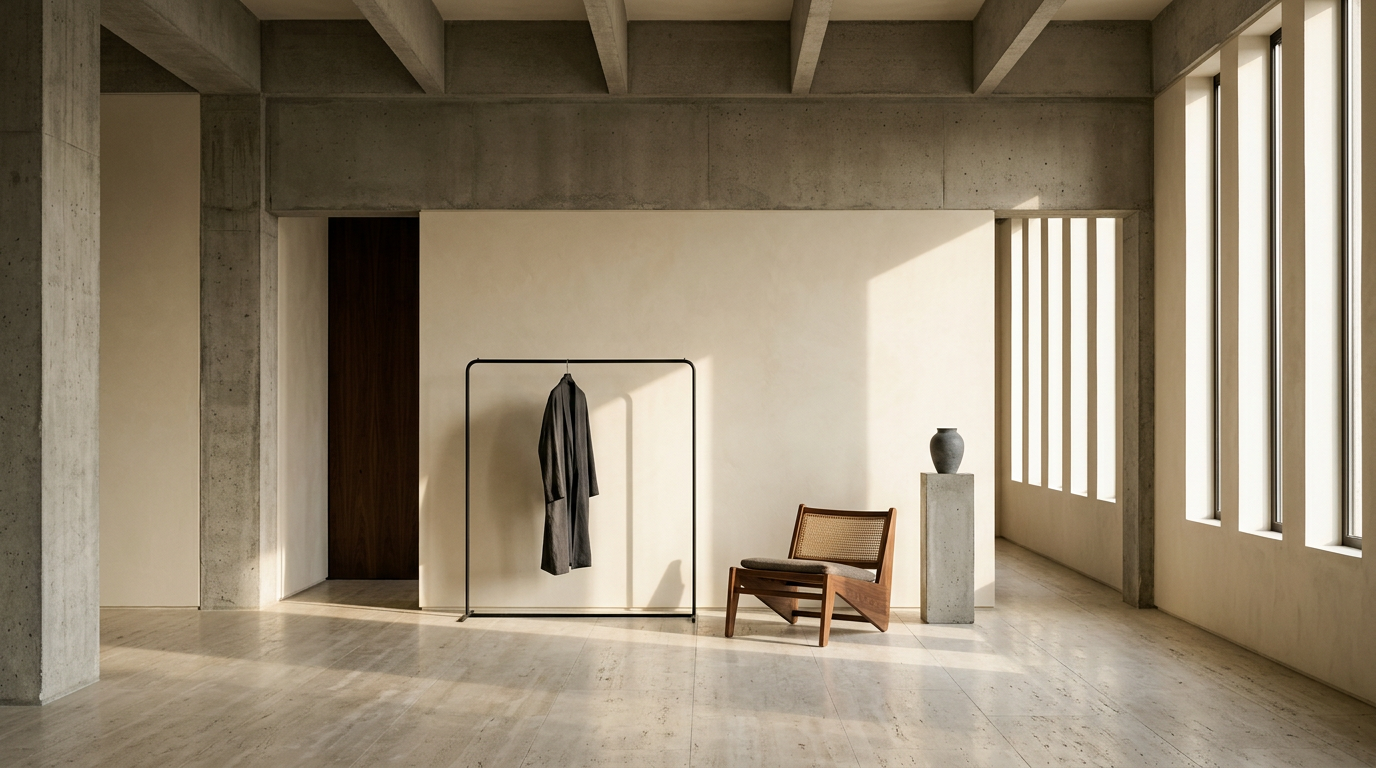
At Salone del Mobile 2026, Swedish colorist Teklan and acoustic specialist Slalom presented "Soft Cubism," an installation that frames sound management as a design discipline rather than an engineering afterthought. The collaboration introduces a mineral-derived color palette applied to modular acoustic panels, proposing that the visual and auditory dimensions of interior space should be designed as a single system. The project is anchored in what the brands term "Acoustethics" — a framework linking acoustic performance, ethical material sourcing, and a deliberate visual language.
The installation arrives at a moment when the design industry is grappling with the consequences of two decades of open-plan orthodoxy. Glass partitions, polished concrete, and hard minimalist surfaces have become default choices in offices, hotels, and public buildings, often producing environments where sound ricochets and accumulates. Acoustic panels have long existed as a corrective, but their treatment has remained largely functional — felt rectangles in neutral grays, mounted as an apology rather than an intention. Teklan and Slalom position "Soft Cubism" as a departure from that logic.
Color as Structure, Not Surface
Teklan's contribution centers on a palette of mineral and light-responsive tones developed to interact with geometry and ambient light rather than simply coat a surface. The approach draws on a tradition of architectural color theory — the idea, explored by figures from Josef Albers to the contemporary Scandinavian design schools, that color perception shifts with material, angle, and illumination. In this framework, a muted terracotta or a chalky blue-gray is not decorative; it is spatial, altering how a room feels in depth and scale.
The palette explicitly rejects the monochromatic tendencies that have dominated corporate and hospitality interiors in recent years. Where many acoustic products default to black, charcoal, or off-white to avoid visual disruption, the Teklan-Slalom range treats color as a positive element — one that can modulate mood and perception alongside sound absorption. The nature-inspired hues are intended to register as subtle presences rather than focal points, a distinction that separates the project from more expressive acoustic installations that have appeared at previous editions of Salone.
Acoustics and the Limits of Open Space
The broader context for "Soft Cubism" is a growing body of research linking open-plan environments to cognitive fatigue and reduced productivity. Studies from institutions including Harvard and the Technical University of Denmark have documented how unmanaged reverberation in shared workspaces increases stress hormones and diminishes concentration. The design industry's response has been incremental — phone booths, fabric dividers, ceiling baffles — but rarely integrated into a cohesive spatial philosophy.
Slalom's acoustic expertise gives the collaboration technical credibility in this space. By pairing sound-dampening performance with Teklan's color system, the project proposes that architects and interior designers should treat auditory and visual comfort as interdependent variables. A panel's color, texture, and geometry all influence how a room is perceived; the argument embedded in "Soft Cubism" is that optimizing one dimension while ignoring the others produces incomplete environments.
The installation's title itself signals an aesthetic lineage. Cubism fragmented form to reveal multiple perspectives simultaneously. "Soft Cubism" borrows the geometric vocabulary but strips away the aggression, suggesting that modular, faceted surfaces can create visual rhythm while absorbing the noise that hard-edged modernism generates. Whether this synthesis gains traction beyond the exhibition floor depends on how effectively the system translates to real architectural programs — offices, healthcare facilities, educational buildings — where acoustic performance is measured in data, not atmosphere.
The tension at the heart of the project is familiar but unresolved: the design world values visual impact, while acoustic engineering values measurable absorption coefficients. "Soft Cubism" bets that these goals are not in conflict. Whether specifiers and architects treat the proposition as a genuine toolkit or as another Salone moment — compelling in Milan, forgotten by autumn — remains the open question.
With reporting from Designboom.
Source · Designboom