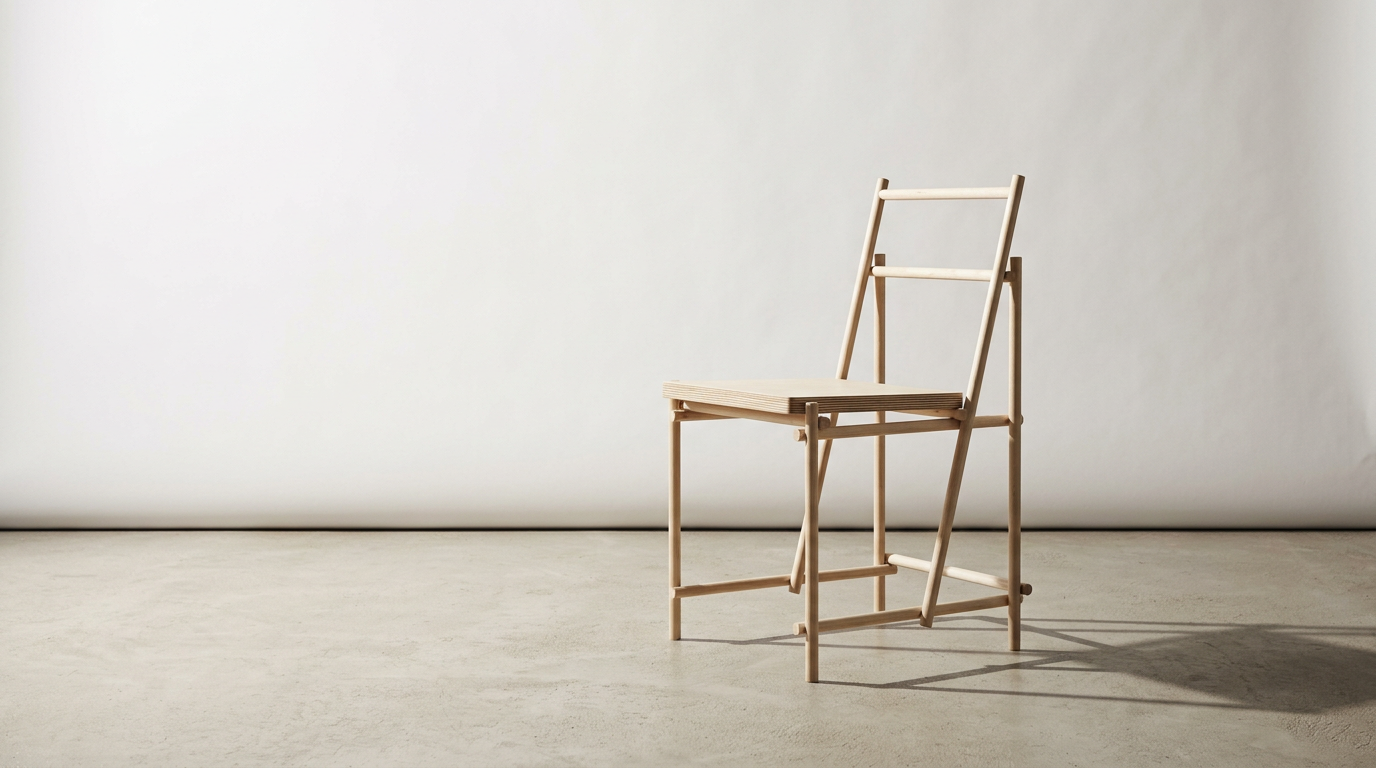
At the Estonian Academy of Arts (EKA), first-year architecture and interior architecture students face a deceptively simple brief: build a full-scale, functional chair from a restricted kit of pre-cut wooden sticks and plywood. No upholstery, no composite materials, no generous budgets. The constraint is the curriculum. The results, refined over a decade of pedagogical iteration, now form the basis of "Manifesto of Lightness," an exhibition curated by Finnish designer Ilkka Suppanen for Milan's SaloneSatellite 2026.
The pieces on display range from a Bauhaus-inspired ergonomic chair to a bench shaped through the wet-bending of wooden slats. Each object functions as both furniture and argument — a physical case that strength and comfort do not require material abundance, but rather a disciplined understanding of engineering, joinery, and form.
Constraint as pedagogy
Design education has long used the chair as a proving ground. The object is familiar enough to invite assumption and complex enough to punish it. A chair must bear dynamic loads, accommodate varied human proportions, and remain stable across multiple planes of force — all while being, at minimum, tolerable to sit in. When the available material is reduced to a handful of wooden sticks, every joint and angle carries structural consequence.
The EKA approach belongs to a broader tradition of constraint-driven design teaching. The Bauhaus preliminary course, developed in the 1920s, similarly forced students to confront material properties before style. Enzo Mari's "Autoprogettazione" project in 1974 offered the public plans for furniture built from rough lumber and nails — not as austerity, but as a political statement about accessible making. What distinguishes the Estonian program is its sustained institutional commitment: a decade of refining the same exercise, treating the wooden-stick chair not as a one-off assignment but as a diagnostic tool for structural thinking.
By stripping away surface decisions — color, textile, finish — the studio isolates the architectural skeleton of seating. Students must negotiate the relationship between compression and tension in real material, at real scale. The pedagogical bet is that designers trained under such discipline will carry a structural intuition into more complex projects later in their careers.
Lightness in an era of material scrutiny
The exhibition's title, "Manifesto of Lightness," carries deliberate weight. Industrial furniture design faces growing scrutiny over material throughput, embodied carbon, and end-of-life disposal. Flat-pack furniture optimized for logistics rather than longevity dominates global markets. Against that backdrop, a chair built from minimal wood that nonetheless holds a human body becomes a quiet counterpoint.
The word "manifesto" signals intent beyond the academic exercise. Presenting student work at SaloneSatellite — Milan's platform for emerging designers — positions these objects within a professional discourse about what responsible production might look like. The claim is not that all furniture should be skeletal, but that the design process itself benefits from starting at the minimum viable structure and adding material only where function demands it.
This resonates with parallel movements in architecture, where firms increasingly pursue material reduction through computational optimization and engineered timber. The logic is similar at every scale: understand where forces flow, place material along those paths, remove everything else.
Whether the EKA approach produces furniture suited to commercial production is, in some sense, beside the point. The chairs are pedagogical artifacts first. Their value lies in what they teach the people who build them — and in the question they pose to an industry accustomed to solving problems by adding material rather than subtracting it. That a handful of wooden sticks can support a seated body is not, in itself, a revelation. That an entire curriculum can be organized around proving it, year after year, suggests something about where design education believes rigor still resides.
With reporting from Dezeen.
Source · Dezeen