In 1944, as the world prepared for the staggering logistics of post-war reconstruction, Ray and Charles Eames identified a crisis of scale. With an estimated fifty million families displaced by the conflict, the couple argued in Arts & Architecture magazine that traditional building techniques were no longer sufficient to meet the global demand for shelter. Their solution, eventually realized in the 1949 Eames House — also known as Case Study House #8 — was not an exercise in bespoke luxury, but a radical appropriation of industrial components: parts designed for factories and airplanes repurposed into a domestic sanctuary. The house became one of the most celebrated residential structures of the twentieth century, a proof of concept that mass-produced materials could yield architecture of genuine warmth and beauty.
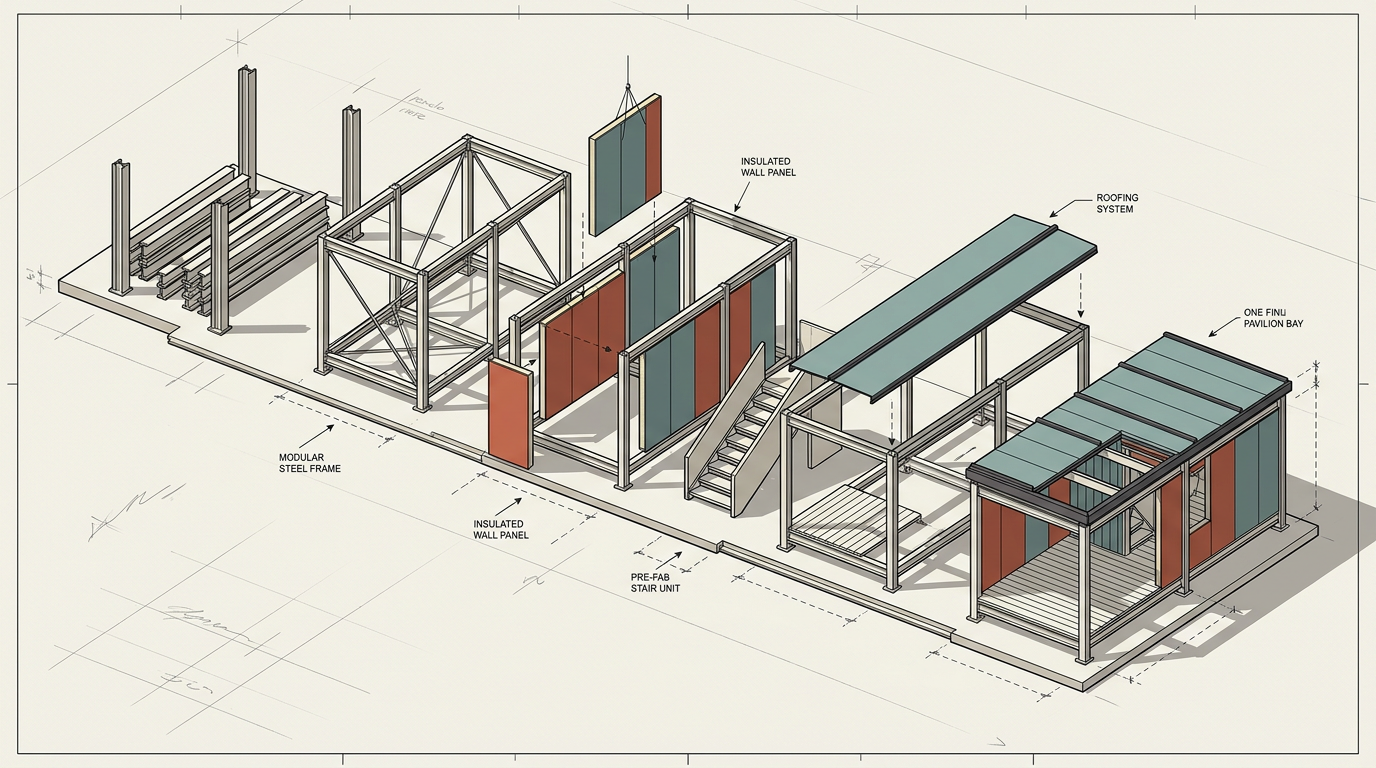
Today, the original Eames House stands in Pacific Palisades as a protected landmark, a static monument to mid-century modernism. However, the Eames Office is now returning to the couple's original, more fluid vision with the Eames Pavilion System. This new prefabricated housing project moves away from the idea of the house-as-object and toward the house-as-system, allowing owners to "collage" industrial modules into unique, modular configurations. According to Eames Demetrios, grandson of the founders and director of the Eames Office, the goal is not to produce replicas of a twentieth-century icon, but to distill its underlying logic.
From landmark to living system
The tension between preservation and propagation has defined the Eames legacy for decades. Landmarked buildings, by their nature, freeze a design at a single moment. The Eames House became an artifact — studied, photographed, conserved — but its animating idea, that architecture should be assembled from readily available industrial parts the way a sentence is assembled from words, was largely left on the shelf. The Case Study House program that produced it, organized by Arts & Architecture editor John Entenza in the postwar years, commissioned dozens of experimental residences across Southern California. Most remained one-offs. The program demonstrated what was possible without establishing a repeatable method for broad adoption.
The Eames Pavilion System represents an attempt to close that gap. By treating architecture as a kit of parts rather than a finished composition, the project reframes the designer's role. The architect provides the grammar — structural modules, connection details, material palettes — while the inhabitant constructs the sentence. This approach has clear precedents in design history. Jean Prouvé's demountable houses in postwar France pursued a similar logic, as did Buckminster Fuller's Dymaxion experiments. What distinguishes the Eames iteration is its explicit lineage: the system does not merely echo mid-century industrial idealism but claims direct descent from a specific, well-documented prototype.
The move also arrives at a moment when prefabricated and modular construction has re-entered mainstream architectural discourse. Rising material costs, persistent housing shortages in major metropolitan areas, and growing interest in reducing construction waste have pushed factory-built housing from the margins toward the center of policy and design conversations. The Pavilion System positions itself within that current, though its emphasis on customization — the "collage" principle — sets it apart from more standardized modular offerings.
Industrial efficiency meets individual expression
The core proposition of the Eames Pavilion System rests on a duality that has long been difficult to resolve in prefabricated housing: how to achieve the cost and speed advantages of industrial production without producing rows of identical boxes. The original Eames House managed this by treating off-the-shelf steel decking, factory sash windows, and standard structural sections as a palette rather than a prescription. The result was a home that felt personal, even idiosyncratic, despite being assembled almost entirely from catalog components.
Whether the Pavilion System can replicate that balance at scale is an open question. Modular housing projects have historically struggled with one of two failure modes: either the system is so flexible that costs spiral upward and assembly becomes bespoke by another name, or it is so rigid that the promise of individual expression rings hollow. The Eames name carries cultural authority sufficient to attract attention, but cultural authority alone does not resolve the engineering and economic constraints that have stalled previous efforts.
What the project does accomplish, at minimum, is a reframing of the Eames legacy. Rather than a museum piece admired from behind a velvet rope, the Eames House becomes a set of principles available for reinterpretation. The question is whether the market — buyers, builders, regulators — will treat those principles as a viable foundation for how people actually live, or whether the Pavilion System will remain, like so many elegant prototypes before it, an idea more admired than inhabited.
With reporting from Highsnobiety.
Source · Highsnobiety