A decade ago, an experimental test in the United States showed that a pilot could land a fighter jet from miles away, treating a multi-million-dollar machine like a high-stakes flight simulator. What was then a curiosity confined to controlled laboratory conditions has, in the grinding reality of the Russo-Ukrainian War, become an operational norm. Reports indicate that Ukrainian drone operators are now intercepting Russian Shahed drones from locations as unremarkable as hotel rooms and basements in Kyiv — roughly 500 kilometers from the point of contact. The shift marks a quiet but structurally significant change in how modern air defense is conducted.
The mechanism is straightforward in principle: by replacing short-range radio frequencies, which tether an operator to the immediate vicinity of the hardware, with encrypted internet-based protocols, Ukraine has decoupled the pilot from the front line. A skilled operator no longer needs line-of-sight proximity to the drone. A stable, secure connection is sufficient. The battlefield, in this configuration, extends to wherever a signal can reach.
From radio tether to distributed network
The traditional model of drone warfare assumed a relatively short leash. First-person-view (FPV) drones — small, fast, and cheap — became the signature weapon of the Russo-Ukrainian War from its early phases, but their operators typically worked within a few kilometers of the action, exposed to counter-battery fire, electronic jamming, and the general lethality of the front. The attrition rate among experienced drone pilots became a strategic problem in itself: training a competent operator takes weeks or months, while losing one takes a single artillery round.
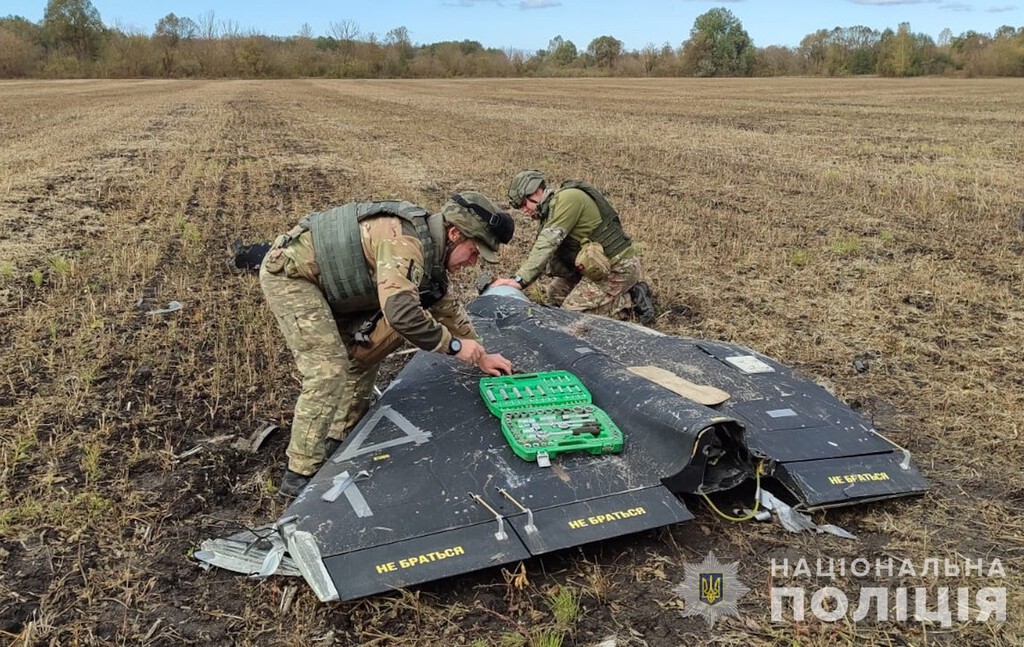
The migration to internet-based control addresses this bottleneck directly. By routing the control signal through encrypted web protocols rather than analog or digital radio, the operator can sit in a secure rear area — a basement in Kyiv, a nondescript hotel room, a hardened facility — and still guide an interceptor drone against an incoming Shahed. The Shahed-136, a loitering munition of Iranian design that Russia has deployed in large numbers against Ukrainian infrastructure, follows predictable flight paths at relatively low speeds, making it a viable target for remotely piloted interceptors if the latency of the connection remains manageable.
This logistical abstraction carries implications beyond individual engagements. A single specialized pilot can, in theory, intervene in multiple theaters of operation without relocating. The model treats the operator not as a frontline combatant but as a node in a distributed network — callable, rotatable, and far less exposed to physical risk.
The geography of combat, rewritten
The broader significance lies in what this does to the concept of a front line. Historically, the geography of war was defined by the physical presence of combatants and their weapons. Air defense meant batteries positioned within range of expected threats, crewed by personnel who accepted the risk of proximity. The Ukrainian adaptation inverts this logic: the hardware remains forward-deployed, but the human decision-maker retreats to safety, connected by infrastructure that is civilian in origin and military in application.
This is not without vulnerabilities. Internet-based control introduces dependencies on network infrastructure, which can be degraded by cyberattack, physical destruction of relay nodes, or simple congestion. Latency — the delay between a pilot's input and the drone's response — becomes a critical variable when intercepting a target moving at speed. And the approach assumes a level of connectivity that may not be uniformly available across all operational zones.
Still, the pattern is difficult to ignore. Wars have historically accelerated the adoption of technologies that were, in peacetime, considered experimental or impractical. Radio itself followed this trajectory in the First World War; GPS-guided munitions did so in the Gulf War. The use of consumer-grade internet connections to conduct air defense operations at distance fits squarely within this lineage — a pragmatic adaptation born of necessity rather than doctrine.
The question that remains open is whether this model scales, and whether adversaries can counter it faster than it proliferates. Electronic warfare, network disruption, and AI-assisted autonomous drones that require no human pilot at all represent competing pressures. The "war from the basement" may prove to be a transitional phase — a bridge between the era of the human operator and the era of full autonomy — or it may become the enduring template for how smaller nations defend themselves against industrial-scale drone campaigns. The forces pulling in each direction are already visible. Which prevails is not yet settled.
With reporting from Xataka.
Source · Xataka