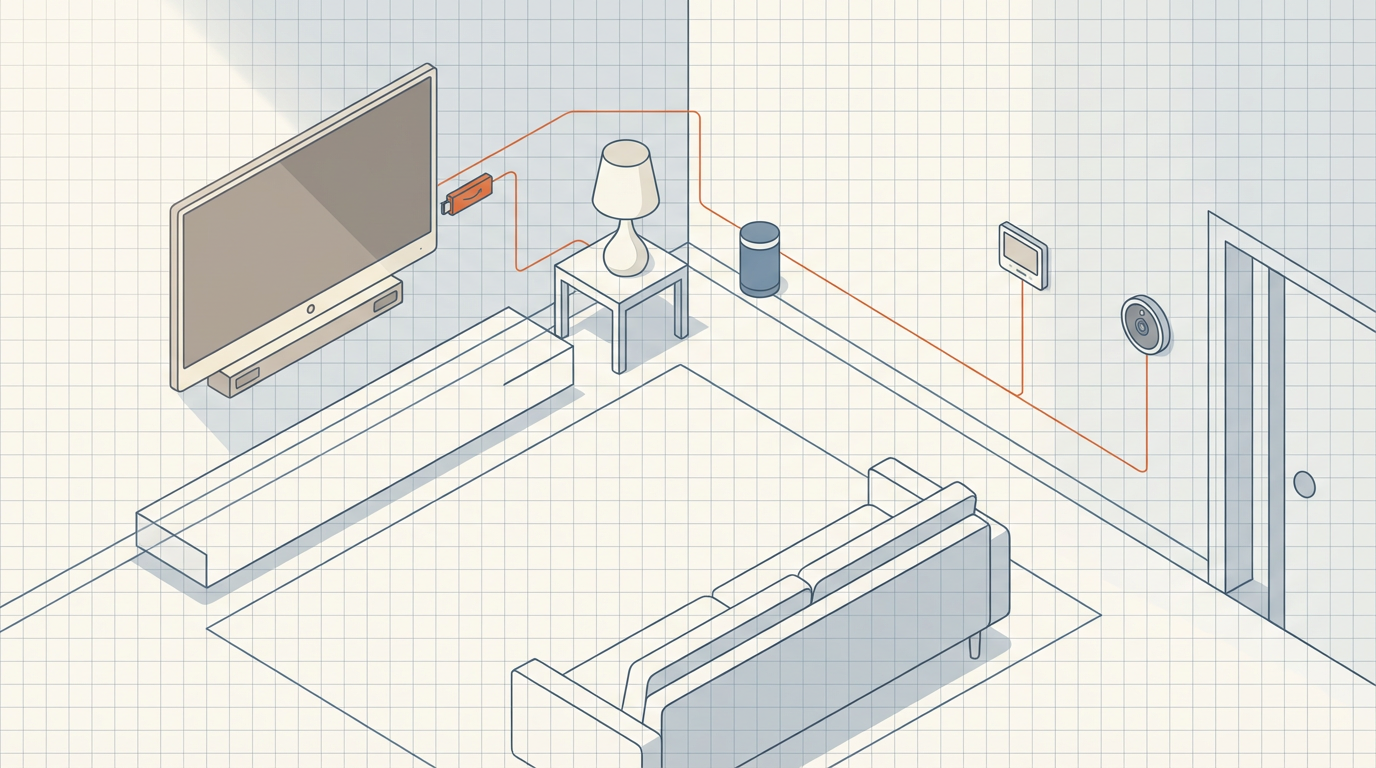
The living room remains the primary site of domestic digital integration, a space where the battle for the HDMI port has shifted from raw resolution to ecosystem dominance. Recent hardware updates and promotional cycles — particularly visible in the Brazilian consumer electronics market — highlight how streaming sticks have evolved from simple media bridges into essential hubs for the broader smart home. What was once a commodity purchase driven by codec support and pixel count is now a strategic decision about which technology company gets to mediate daily life.
Amazon's latest Fire TV Stick HD exemplifies this trend toward consolidation, embedding Alexa voice control and smart home management directly into the television interface. By lowering the barrier to entry for high-definition streaming, these devices are less about selling hardware and more about securing a permanent foothold in the user's daily digital habits. The television becomes an Alexa endpoint — a portal through which Amazon can surface its retail ecosystem, its subscription services, and its growing network of compatible smart home devices. The margin on the stick matters far less than the lifetime value of the household it enters.
Two models of ecosystem strategy
The 2025 Roku Streaming Stick HD suggests a different path: interoperability. By supporting Alexa, Siri, and Google Assistant simultaneously, Roku acknowledges the fragmented nature of modern smart homes. This pragmatic approach to the "voice assistant wars" allows the hardware to function as a neutral gateway, prioritizing user interface clarity over proprietary lock-in.
The contrast between these two approaches maps onto a broader strategic tension in consumer technology. Amazon, Apple, and Google each operate vertically integrated ecosystems where hardware, software, and services reinforce one another. A Fire TV Stick is not merely a streaming device; it is an onboarding mechanism for Alexa routines, Ring camera feeds, and Amazon Music subscriptions. Roku, lacking a comparable services stack, competes instead on neutrality — the promise that it will not privilege one content provider or assistant over another. This is the same logic that once made the web browser a contested interface: the entity that controls the default screen controls the economics of attention downstream.
The distinction carries practical weight for households that have already accumulated devices across multiple ecosystems. A family with Google Nest speakers, an Apple iPhone, and an Amazon Echo in the kitchen faces a coordination problem that no single vendor has fully solved. Roku's multi-assistant support addresses this reality directly, while Amazon's approach bets that convenience within a single ecosystem will eventually outweigh the friction of fragmentation.
Hardware fades, software persists
Even the market for secondary accessories — universal voice remotes, protective silicone housings, extended warranty bundles — reflects a maturing product category. As streaming devices become permanent fixtures of the household rather than annual upgrades, the focus has turned toward durability and tactile refinement. The hardware is becoming invisible, integrated into the fabric of the home, while the software ecosystems it hosts grow more pervasive.
This trajectory mirrors what happened with home Wi-Fi routers over the past decade. Once a visible piece of technology that consumers actively selected and configured, the router receded into infrastructure — a commodity whose brand mattered less than the network services layered on top. Streaming sticks appear to be following the same arc. Price competition has compressed margins to the point where differentiation on hardware specifications alone is nearly impossible. What remains is the interface: the home screen, the voice assistant, the recommendation algorithm, the default search behavior.
For consumers, the implication is that the most consequential choice is no longer which device delivers the sharpest picture, but which company's logic will organize the living room. For the companies themselves, the stakes extend well beyond entertainment. The streaming stick is a beachhead — a low-cost entry point into a household's routines, purchases, and preferences. Whether the winning strategy is Amazon's vertical integration or Roku's horizontal neutrality remains an open question, one that will likely be settled not by technology reviewers but by the slow accumulation of habits in millions of living rooms.
With reporting from Olhar Digital.
Source · Olhar Digital