New Balance has long mastered the art of the "dad shoe," a category defined by functional bulk and a certain unapologetic utilitarianism. With the release of the 5030, the Boston-based brand appears to be performing a bit of speculative arithmetic — synthesizing the DNA of the classic 530 with the turn-of-the-millennium aesthetic of the 2000 to produce a silhouette that reads as both archival excavation and forward projection. The result is a maximalist sneaker that asks what the brand's design language might look like if it kept accelerating past its own history.
Anatomy of an Oversized Proposition
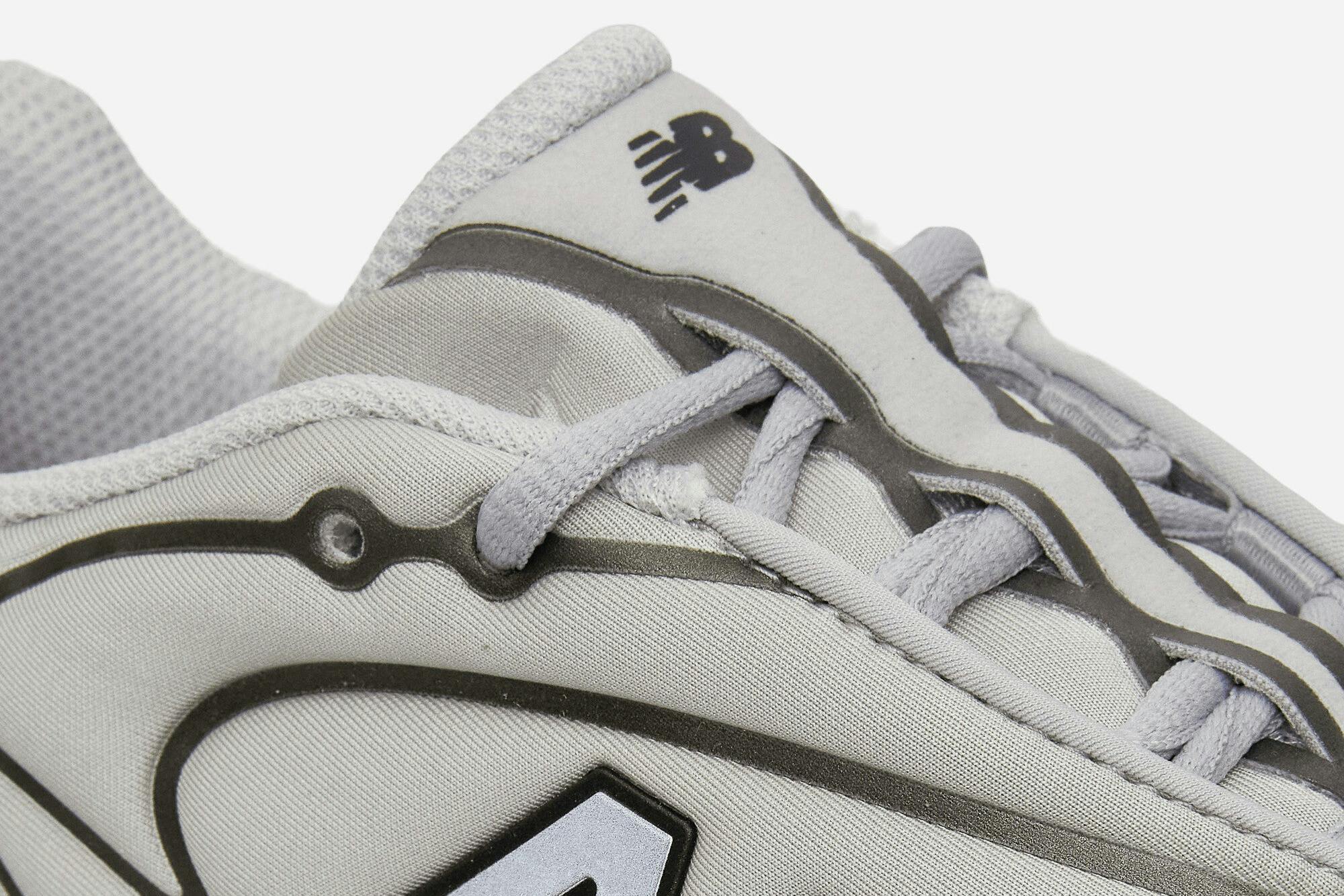
The 5030's silhouette is defined by exaggerated proportions that surpass even the chunky 9060 in scale. Its substantial midsole is equipped with New Balance's signature ABZORB cushioning — a polyurethane-based impact absorption system the brand has deployed across performance and lifestyle lines since the mid-1990s. The upper is characterized by fluid, "wavy" lines, some of which incorporate reflective materials, creating a sense of kinetic energy that contrasts with the shoe's heavy-set footprint. It is an exercise in industrial design that feels both nostalgic for the early digital era and decidedly forward-looking.
Retailing at $120, the 5030 is rolling out in a range of colorways including deep purple, monochromatic black, and a traditional white-and-blue combination. Several iterations are available directly through the brand's digital storefront, while specialized metallic versions are being distributed through select boutique retailers. The pricing positions the shoe in a competitive middle ground — accessible enough to function as a volume play, yet channeled through limited retail partnerships that preserve a degree of scarcity on certain editions.
The strategy is consistent with the playbook New Balance has refined over the past several years. The brand's resurgence in cultural relevance — driven by collaborations with designers and a deliberate embrace of its own unglamorous heritage — has turned its archive into a generative engine. Models like the 990, 550, and 2002R became streetwear staples not by abandoning their utilitarian origins but by leaning into them. The 5030 extends this logic: rather than designing from a blank canvas, New Balance treats its back catalog as raw material for recombination.
The Dad Shoe as Design Laboratory
The broader sneaker market has cycled through several phases of maximalism since Balenciaga's Triple S helped reframe bulk as a luxury proposition in 2017. What began as a provocation — the deliberate embrace of "ugly" footwear — has since become an established design vocabulary. Brands from Asics to Salomon have found commercial traction in silhouettes that prioritize sculptural volume over streamlined minimalism. New Balance's advantage in this landscape is that its chunky proportions were never an affectation. The brand built running shoes for decades before the fashion world decided that thickness was interesting.
That authenticity gives releases like the 5030 a different texture than competitors engineering bulk from scratch. The shoe's lineage — traceable through specific models, specific cushioning technologies, specific design eras — provides a narrative scaffolding that pure fashion labels must construct artificially. Whether this matters to the average consumer browsing colorways online is debatable. But it matters to the retail partners, stylists, and online communities whose endorsement shapes a sneaker's trajectory in its first weeks on the market.
The tension embedded in the 5030 is one New Balance will continue to navigate: how far can archival recombination stretch before it exhausts the source material? The brand's catalog is deep, and its recent track record suggests a disciplined approach to mining it. But each new hybrid silhouette raises the threshold of novelty required to capture attention in a market saturated with chunky propositions. The 5030 lands at a moment when the dad shoe is no longer a subversion — it is the norm. Whether that makes the shoe a natural evolution or a late entry in an already crowded field depends on which force a reader weighs more heavily: the pull of heritage or the diminishing returns of maximalism.
With reporting from Highsnobiety.
Source · Highsnobiety