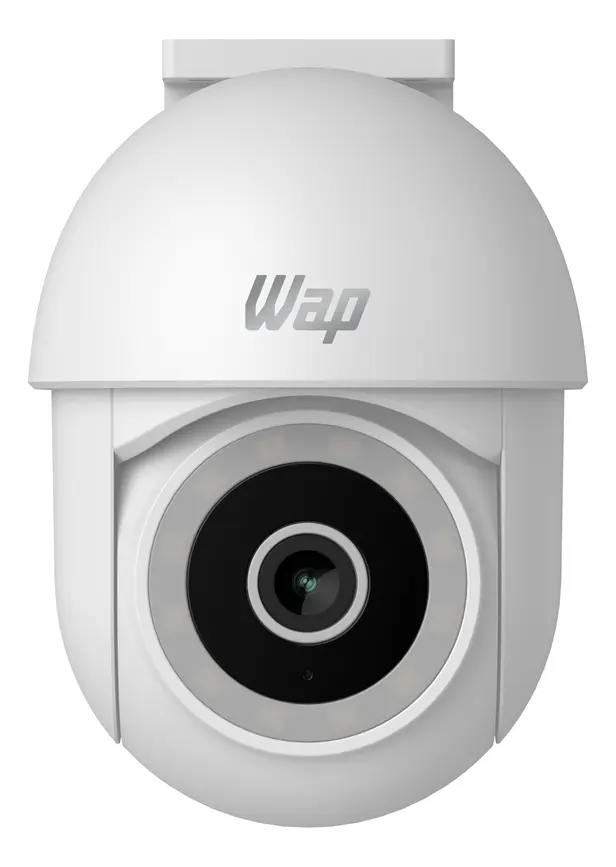
The architecture of domestic security has undergone a quiet but radical transformation over the past decade. What was once the domain of specialized contractors and expensive, hardwired closed-circuit systems has migrated into the realm of the consumer-grade Internet of Things. Devices like the WAP LENS 300 — a compact, 360-degree home camera with two-way audio, mobile integration, and a water-resistant chassis — represent the current endpoint of that migration: surveillance hardware that is affordable enough to be impulse-purchased and simple enough to be installed without professional help.
The trajectory is well established. Early consumer IP cameras, which began appearing in the mid-2010s, offered grainy feeds and unreliable connectivity. Within a few product generations, the category absorbed features that had previously required enterprise-grade equipment: night vision, motion-triggered alerts, cloud storage, and pan-tilt-zoom optics. The WAP LENS 300 sits squarely in this lineage, compressing a panoramic field of view into a single unit and eliminating one of the oldest limitations of fixed-lens cameras — the blind spot.
From Specialized Tool to Household Commodity
The economic logic behind this shift is straightforward. The cost of CMOS image sensors, Wi-Fi chipsets, and small-form-factor motors has fallen steadily, driven by the same supply-chain dynamics that made smartphones ubiquitous. When the core components of a surveillance camera cost pennies, the margin structure of the product changes entirely. Manufacturers compete not on optical exclusivity but on software ecosystems, app responsiveness, and ease of onboarding.
This commoditization carries consequences that extend beyond price tags. A device like the WAP LENS 300, with its two-way audio and echo cancellation, is no longer a passive recording instrument. It functions as a remote-presence tool — a way for a homeowner to speak through a camera mounted above a front door, or for a parent to check on a room from across a city. The line between security device and communication appliance blurs. In practical terms, the same hardware serves as a baby monitor, a pet camera, a doorbell substitute, and a theft deterrent, depending on where it is placed and how its software is configured.
The water-resistant chassis of the WAP LENS 300 underscores another dimension of this evolution: environmental versatility. Traditional consumer cameras were indoor devices; outdoor deployment required a separate product category with different price points and installation requirements. Collapsing that distinction into a single SKU simplifies the purchase decision and expands the addressable market.
The Tension Beneath Accessibility
Yet the democratization of surveillance technology raises questions that the product category has not fully resolved. Each camera added to a home network is also a node on the broader internet, subject to the same firmware vulnerabilities and credential-stuffing attacks that have plagued IoT devices since their inception. The convenience of mobile-first monitoring — the ability to pull up a live feed from anywhere — depends on data traversing cloud infrastructure, which introduces dependencies on third-party servers, privacy policies, and jurisdictional data-protection regimes.
Regulatory frameworks have struggled to keep pace. In the European Union, the Cyber Resilience Act aims to impose baseline security requirements on connected devices, but enforcement timelines remain long relative to product cycles. In other markets, the burden of securing a home camera still falls almost entirely on the consumer — a consumer who, by design, was attracted to the product precisely because it required no technical expertise to set up.
There is also a subtler cultural dimension. When high-fidelity, always-on surveillance becomes a default feature of domestic life rather than a deliberate security investment, the social norms around recording — of family members, of guests, of delivery workers, of neighbors within range — shift without explicit negotiation. The technology arrives frictionlessly; the ethical and legal frameworks around its use do not.
The WAP LENS 300 is, in isolation, an unremarkable product — a competent entry in a crowded category. Its significance lies in what it represents: the point at which residential surveillance crosses from considered purchase to commodity. Whether the infrastructure of trust, security, and regulation can keep pace with that crossing remains an open question, and one that each new product cycle makes more pressing.
With reporting from Olhar Digital.
Source · Olhar Digital