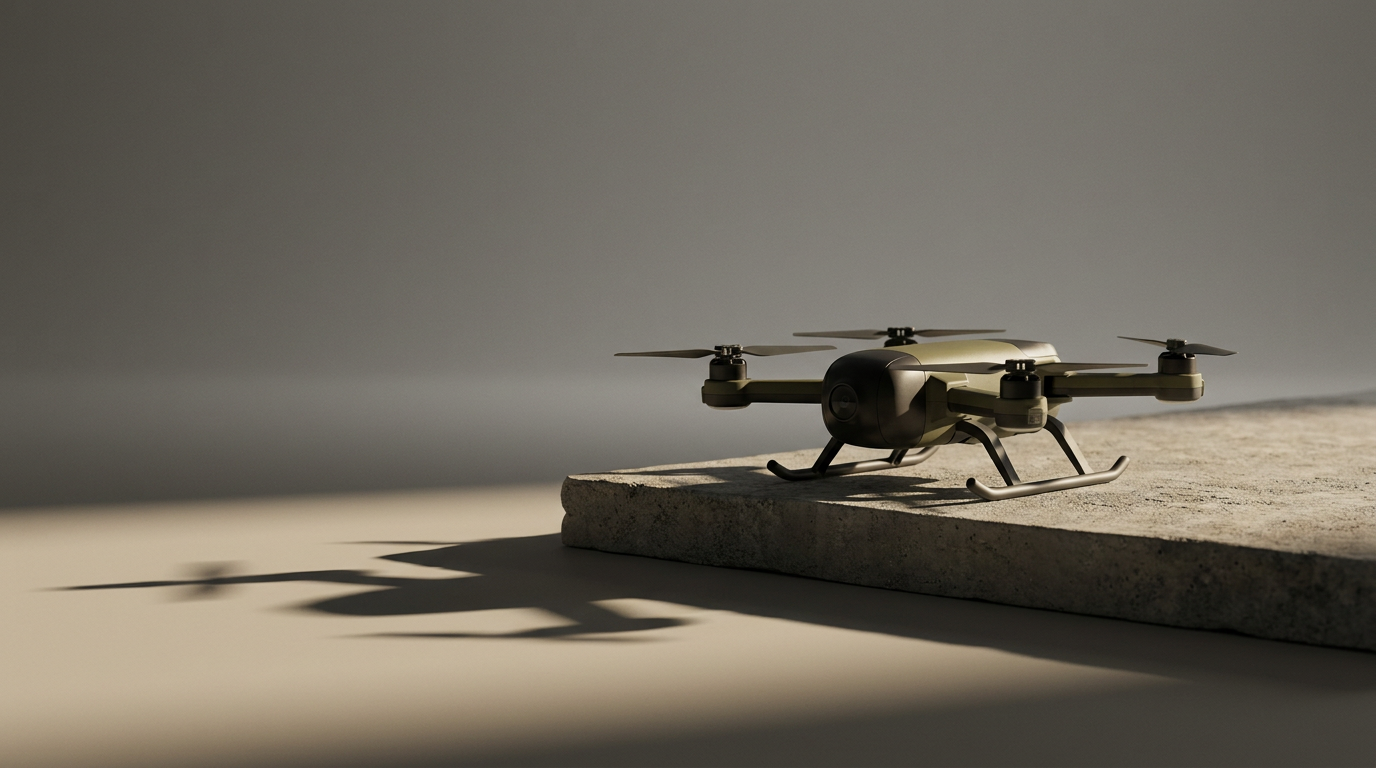
Modern warfare has encountered a small, swift, and ubiquitous adversary: first-person-view drones and commercial quadcopters. Cheap, agile, and increasingly lethal, these platforms have reshaped infantry engagements from Ukraine to the Middle East, forcing armies to rethink air defense at its most granular level. The United States Army's latest response is not a sophisticated electronic jammer or a guided missile but a cartridge — the "Drone Round," developed by Drone Round Defense — that turns a standard NATO rifle into something closer to a shotgun.
Available in 5.56×45mm and 7.62×51mm, the round looks like conventional ammunition but behaves differently the moment it leaves the barrel. Five to eight mini-pellets disperse into a cloud of fragments designed to engage targets at distances between 50 and 100 meters. The effect is a drastically wider hit probability against small, fast-moving objects that would be nearly impossible to neutralize with a single precision shot.
From pest control to the front line
The conceptual lineage of the Drone Round is surprisingly domestic. For decades, American farmers have used scattershot cartridges to cull small, fast-moving animals — birds raiding crops, rodents near grain stores. The ballistic principle is identical: when the target is small and unpredictable, a cloud of projectiles outperforms a single slug. Drone Round Defense has essentially transplanted that logic into a military context, repackaging an agricultural tool as a battlefield countermeasure.
This kind of cross-domain adaptation is not unusual in the history of military technology. Barbed wire was a ranching innovation before it defined the Western Front. The Jeep descended from civilian utility vehicles. What distinguishes the Drone Round is the speed of the cycle: the threat it addresses — cheap commercial drones weaponized for combat — barely existed a decade ago, and the solution borrows from a practice that predates modern firearms regulation. The gap between problem identification and fielded response is remarkably short by defense-procurement standards.
The tactical advantage is straightforward. A soldier carrying standard magazines loaded with a mix of conventional and Drone Rounds does not need to swap weapons when an FPV drone appears at close range. Shotguns, while effective against small aerial targets, are heavy, low in rate of fire, and occupy a weapon slot that most infantry squads cannot spare. By embedding the counter-drone capability inside the existing rifle platform, the Army keeps the logistical footprint minimal and the response time short.
The broader counter-drone puzzle
The Drone Round addresses one narrow slice of a much larger problem. Small unmanned aerial systems now operate across a spectrum that ranges from commercial quadcopters costing a few hundred dollars to military-grade loitering munitions with autonomous guidance. Electronic warfare systems — GPS jammers, RF disruptors — remain the primary line of defense at the unit level, but they struggle against drones that navigate by visual inertia or pre-programmed waypoints. Directed-energy weapons, including high-powered microwave and laser systems, are progressing through testing phases in several NATO countries, yet none has reached the maturity or price point required for widespread infantry deployment.
Kinetic solutions like the Drone Round therefore occupy a specific niche: the last-ditch, close-range engagement where electronic countermeasures have failed or are unavailable. Their value is less as a standalone system than as one layer in a defense-in-depth architecture that military planners are still assembling.
The deeper tension is economic. Drones are cheap; most countermeasures are not. A guided missile fired at a commercial quadcopter represents an inversion of the cost calculus that has governed air defense since the surface-to-air missile era. Ammunition-based solutions partially restore the balance — a Drone Round is orders of magnitude less expensive than a missile — but the arithmetic only holds if the engagement window is close enough for rifle-caliber dispersion to be effective. Beyond 100 meters, the fragments lose coherence, and the infantryman is back to relying on systems further up the cost curve.
What remains unresolved is whether the proliferation of counter-drone tools at the squad level will keep pace with the evolution of the drones themselves. Swarm tactics, autonomous navigation, and ever-smaller airframes continue to compress the decision loop. The Drone Round solves today's close-range engagement problem with elegant simplicity — but the question of whether tomorrow's drones will still fly slowly and low enough to be met by a rifle cloud hangs over every kinetic solution currently entering service.
With reporting from Olhar Digital.
Source · Olhar Digital