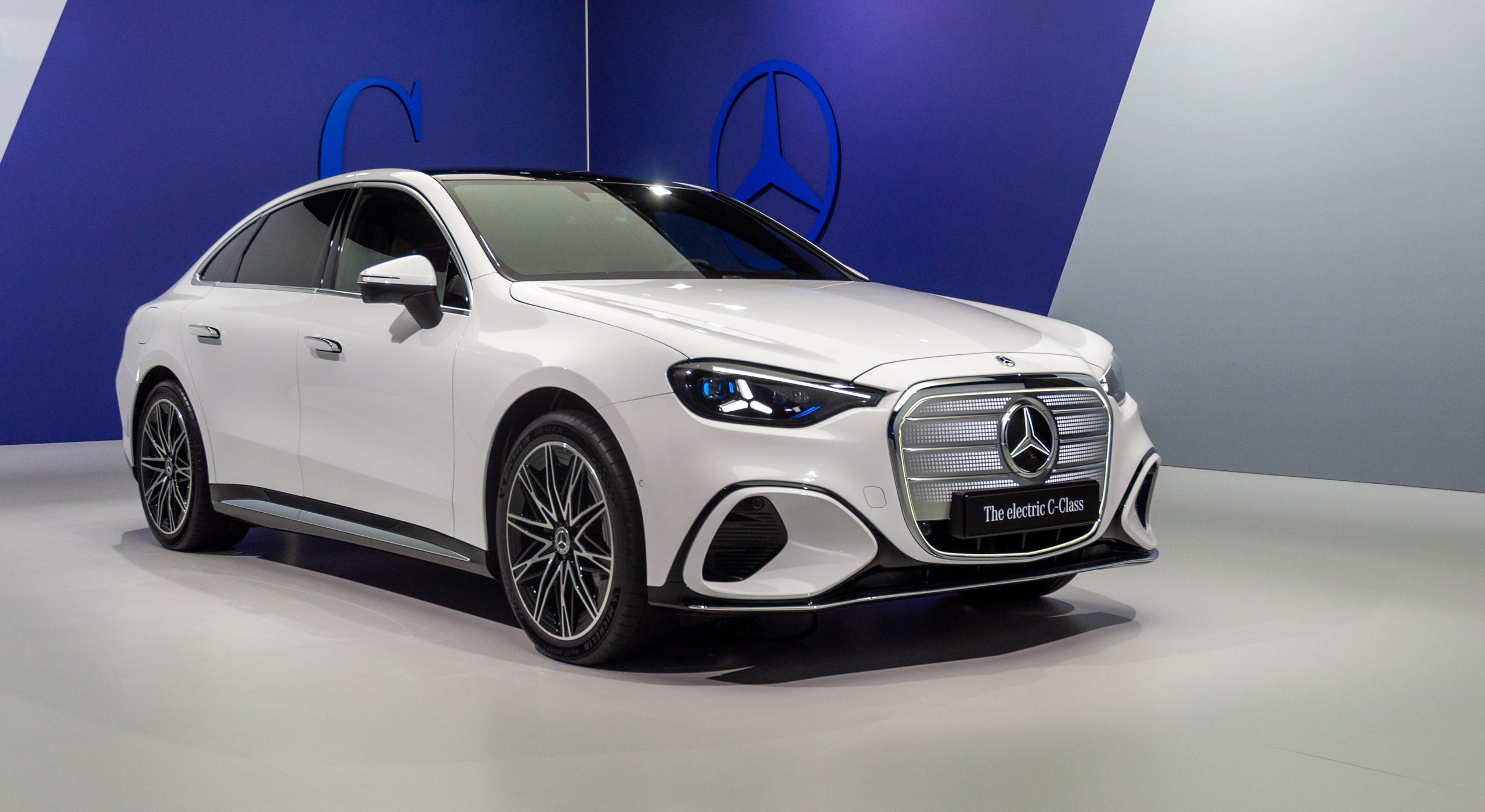
The Mercedes-Benz C-Class has long served as the automotive industry's bellwether for the executive sedan — a vehicle that balances aspiration with mass-market pragmatism. For its 2027 iteration, Mercedes is steering this legacy into a purely electric future, unveiling a model that emphasizes aerodynamic efficiency and a maximalist approach to digital interfaces. While a combustion-powered version is expected to follow, this electric debut sets the pace for the brand's next generation of mid-sized luxury.
The C-Class is not a peripheral model for Mercedes-Benz. It is the brand's volume anchor in the premium sedan segment, the car most likely to serve as a buyer's first encounter with the three-pointed star. Choosing it as the vehicle to lead an electric transition — rather than a niche sports car or a flagship limousine — carries strategic weight. It signals that electrification at Mercedes is no longer confined to the EQ sub-brand or to halo products like the EQS. It is moving into the core of the lineup.
Heritage as Aerodynamic Strategy
Visually, the new C-Class is a study in calculated nostalgia and aggressive modernization. The front fascia pays homage to the W126 era with an upright "egg crate" grille, though it is reimagined here with over a thousand points of backlighting. This heritage is contrasted by a silhouette defined by raked A-pillars and a tapered rear, both engineered to minimize drag and maximize its nearly 400-mile range. The star motif, now a core element of the brand's lighting signature, appears in both the headlights and the full-width rear LED panel.
The emphasis on aerodynamics reflects a broader lesson the industry has absorbed over the past several years: for battery-electric vehicles, range is won as much in the wind tunnel as in battery chemistry. Mercedes has pursued this logic before — the EQS sedan launched with one of the lowest drag coefficients of any production car — and the new C-Class appears to extend that philosophy into a more accessible price segment. The design language attempts to thread a difficult needle: looking distinctly like a Mercedes while obeying the physical constraints that electric powertrains impose on vehicle shape.
The Hyperscreen and the Software-Defined Interior
Inside, the cabin is dominated by the "Hyperscreen," an expansive, pillar-to-pillar glass dashboard that integrates multiple displays into a single seamless unit. It is a design choice that reflects the industry's broader shift toward software-defined vehicles, where the physical dashboard is essentially replaced by a digital canvas. Mercedes first introduced the Hyperscreen concept in the EQS, where it drew both admiration for its visual impact and criticism for burying basic controls behind layers of software menus. Its migration to the C-Class suggests Mercedes views the format as scalable — and that the company is betting screen-forward interiors will become the norm rather than the exception in premium cars.
This bet is not without tension. Regulators in Europe have begun scrutinizing touchscreen-heavy dashboards for their potential to distract drivers, and competitors like BMW and Porsche have publicly recommitted to physical controls for key functions. The question for Mercedes is whether a maximalist digital interior enhances the ownership experience or introduces friction that erodes the very sense of refinement the brand has historically sold.
Paired with significant fast-charging capabilities, the 2027 C-Class aims to bridge the gap between traditional luxury and the high-tech demands of the modern driver. The nearly 400-mile range figure, if it holds under real-world conditions, would place the car competitively against key rivals in the segment and address one of the most persistent objections to electric vehicle adoption among premium buyers.
What remains to be seen is how the market receives an electric C-Class that arrives alongside a promised combustion variant. Mercedes is effectively asking two different buyer profiles to coexist under the same nameplate — one drawn to the quiet torque and digital immersion of an EV, the other still attached to the internal combustion engine that defined the C-Class for decades. Whether a single model line can credibly serve both audiences, or whether the electric version cannibalizes the combustion one before infrastructure catches up, is a question that extends well beyond Stuttgart. It sits at the center of every legacy automaker's transition strategy.
With reporting from The Drive.
Source · The Drive