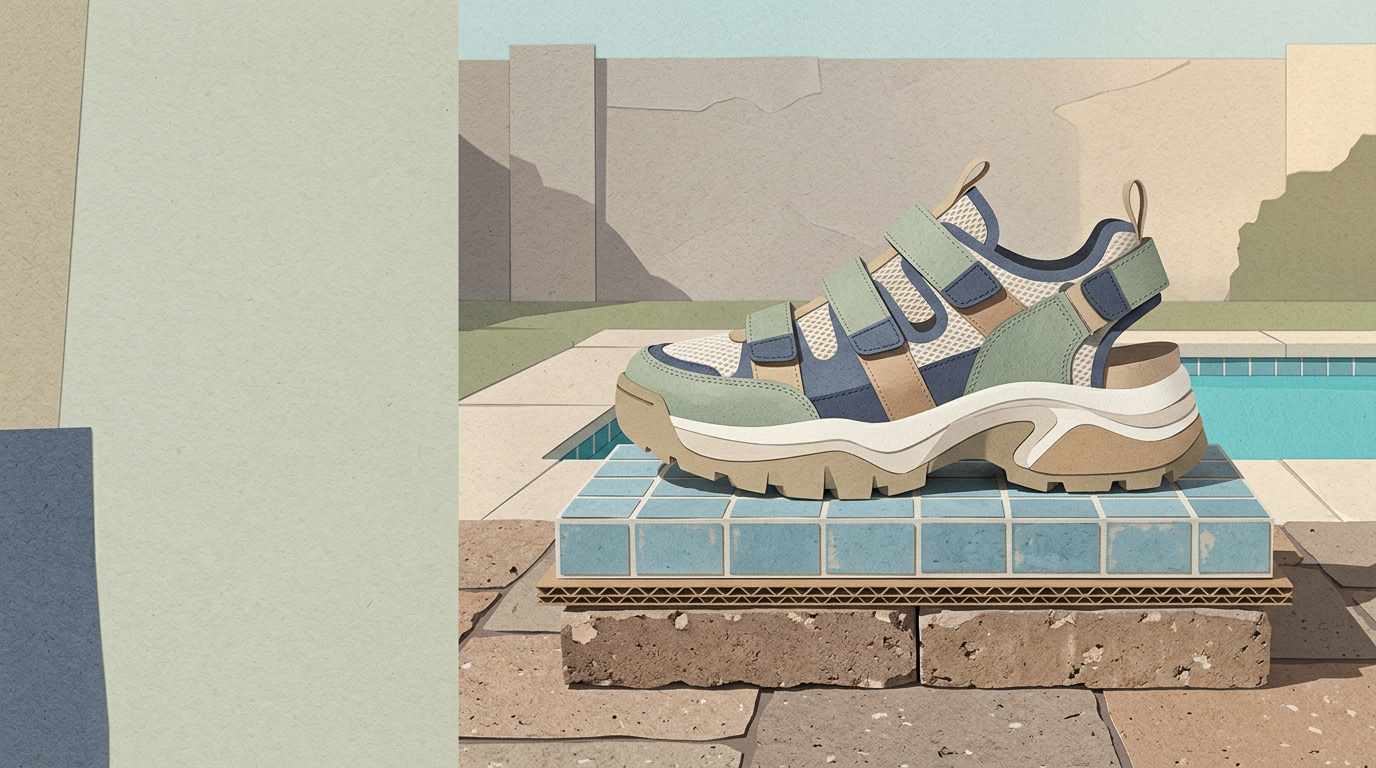
The ASICS GEL-1130 has completed the quintessential modern fashion arc. Originally released in the 2000s as a budget-friendly, entry-level runner, it spent years as a staple of suburban utility before being reclaimed by the "dad shoe" movement. By last year, it was the best-selling silhouette on the resale platform StockX — a testament to the industry's ongoing fixation with the aesthetics of the mundane. Now, for its Summer 2026 collection, ASICS is pushing the silhouette further still: the GEL-1130 CV is a hybrid model that strips the sneaker down into an orthopedic-style sandal, retaining the signature chunky, cushioned sole while adding double straps, an open toe, and heel cutouts.
The move is less a departure than a logical extension. The GEL-1130's commercial trajectory already traced a familiar path in contemporary footwear — from functional anonymity to ironic adoption to genuine desirability. The CV variant simply accelerates the cycle, arriving at a destination that would have seemed absurd a decade ago: a performance running shoe deconstructed into something closer to a poolside slide.
The economics of ugly
The "dad shoe" phenomenon, broadly defined, has been one of the most durable trends in fashion over the past decade. Its roots stretch back to Balenciaga's Triple S, introduced in 2017, which demonstrated that exaggerated, deliberately graceless footwear could command luxury pricing and cultural cachet. What followed was an industry-wide recalibration. Brands across the spectrum — from New Balance to Salomon to Hoka — found that chunky, utilitarian silhouettes resonated with consumers who had grown skeptical of sleekness as a default aesthetic value.
ASICS was a relatively late beneficiary of this shift, but an effective one. The GEL-1130 and its sibling the GEL-Kayano 14 became streetwear staples not through aggressive repositioning but through a kind of passive rediscovery. The shoes were already in production, already affordable, already worn by the demographic that fashion's tastemakers had decided to reference. The brand's task was less about reinvention than about availability — ensuring the right colorways reached the right retailers at the right moment.
The GEL-1130 CV represents a more deliberate creative bet. By hybridizing a running shoe with a sandal, ASICS enters territory that brands like Suicoke and visvim have cultivated for years: technical outdoor footwear reimagined as lifestyle product. The difference is scale. ASICS operates at a volume and price point that those niche labels do not, which means the CV's success or failure will say something about how far the mainstream consumer is willing to follow the "ugly" thesis.
Comfort as ideology
Beneath the irony lies a more straightforward proposition: comfort sells. The broader footwear market has shifted measurably toward cushioning, arch support, and ergonomic design — trends driven partly by an aging consumer base, partly by post-pandemic lifestyle changes that elevated casual dress, and partly by a generation of younger buyers who reject the notion that style requires physical discomfort. The GEL-1130 CV, with its foam-heavy sole unit and open construction, sits at the intersection of all three forces.
There is also a strategic dimension worth noting. Sandals and slides occupy a different seasonal window than sneakers, and hybrid designs allow brands to extend a popular silhouette's commercial life across warmer months without cannibalizing the core product. If the CV performs, it gives ASICS a template for treating the GEL-1130 not as a single shoe but as a platform — a modular identity that can be adapted across form factors.
The tension, as always, is between novelty and saturation. The dad shoe's longevity has defied predictions, but every trend carries an expiration risk, and the further a silhouette stretches from its original context, the thinner the cultural logic holding it together becomes. Whether the GEL-1130 CV reads as a clever evolution or a sign that the aesthetic has exhausted its runway may depend less on the shoe itself than on the broader appetite for irony as a design principle — and whether that appetite still has room to grow.
With reporting from Highsnobiety.
Source · Highsnobiety