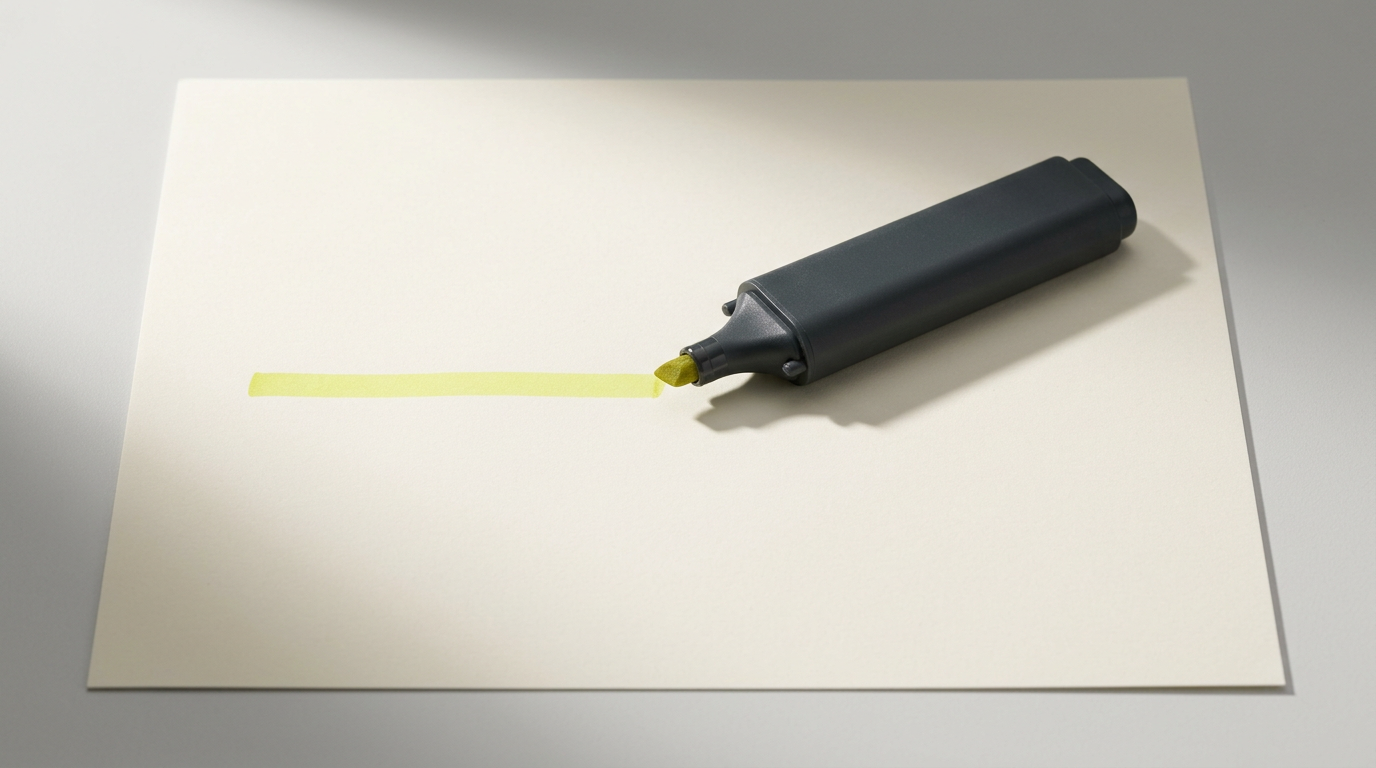
There is a specific strain of Japanese industrial design that views the smallest friction as a failure of engineering. This philosophy—often characterized by an obsessive focus on "micro-inconveniences"—suggests that no object is too mundane to be perfected. The latest example of this pursuit is Pilot's Kire-Na highlighter, a tool designed to solve a problem most users likely assumed was an inevitable part of the medium: the inability to apply consistent pressure.
In analyzing the user experience of traditional highlighters, Pilot's designers identified a recurring issue with the chisel-tip nib. Because humans find it difficult to modulate hand pressure across a single stroke, the resulting lines are often blotchy, inconsistent, or prone to bleeding through the page. While a minor annoyance to the casual reader, Pilot's design team deemed this variability an unacceptable flaw in the writing experience. The solution is a mechanical one: two small protrusions flanking the nib act as physical pressure guides, ensuring uniform contact angle and depth against the paper regardless of how firmly the user presses down.
A Mechanical Fix for a Biological Problem
The Kire-Na's design is a study in functional geometry. The stabilizing protrusions do not alter the ink delivery system or the chemical composition of the ink itself. Instead, they constrain the one variable that traditional highlighter design has always left uncontrolled: the user's hand. It is, in essence, a jig—a concept borrowed from manufacturing, where physical guides ensure repeatable precision in processes that would otherwise depend on human skill.
This approach has deep roots in Japanese product design. The country's stationery industry has long operated on the premise that writing instruments are not commodities but precision tools, each deserving the same rigor applied to higher-stakes engineering problems. Pilot itself has a history of incremental refinement across its product lines, from fountain pens with proprietary feed systems to erasable gel inks that required years of polymer chemistry development. The Kire-Na fits within this lineage: a product where the innovation is not a new material or a digital feature but a subtle reconfiguration of physical form.
The design also reflects a particular understanding of user research. Rather than surveying consumers about their preferences—a method that tends to surface desires for new colors or ergonomic grips—Pilot's team appears to have studied the act of highlighting itself, observing the biomechanics of a hand moving across paper. The distinction matters. Asking users what they want often yields incremental answers. Watching what they struggle with can reveal problems they have stopped noticing.
Analog Precision in a Digital Age
The Kire-Na arrives at a moment when the stationery market occupies a peculiar position. Digital note-taking tools continue to gain adoption, yet the market for premium analog writing instruments has proven resilient, particularly in Japan and parts of East Asia. The consumers who still reach for a physical highlighter tend to be deliberate about their tools. They are students preparing for entrance exams, professionals annotating legal documents, or hobbyists engaged in journaling and planning systems where tactile quality is part of the appeal.
For this audience, the difference between a clean line and a blotchy one is not trivial. It affects legibility, the aesthetic satisfaction of a well-marked page, and in some cases the longevity of the document itself, since ink bleed-through can render the reverse side of a page unusable. By addressing these concerns through geometry rather than chemistry, the Kire-Na sidesteps the trade-offs that often accompany ink reformulations—changes in drying time, color vibrancy, or compatibility with different paper stocks.
The broader lesson extends beyond stationery. In an era when product innovation is often equated with software updates and sensor arrays, the Kire-Na is a reminder that physical objects still contain unsolved problems. The question is whether designers are willing to look closely enough to find them. Pilot's bet is that the market rewards those who do—that a highlighter which draws a cleaner line is not a marginal improvement but a meaningful one, at least to the people who care about lines.
Whether that bet scales beyond the dedicated stationery enthusiast remains an open question. The tension is familiar: hyper-specific design excellence versus mass-market indifference. Most consumers will never notice the problem the Kire-Na solves. The ones who do may never go back.
With reporting from Core77.
Source · Core77