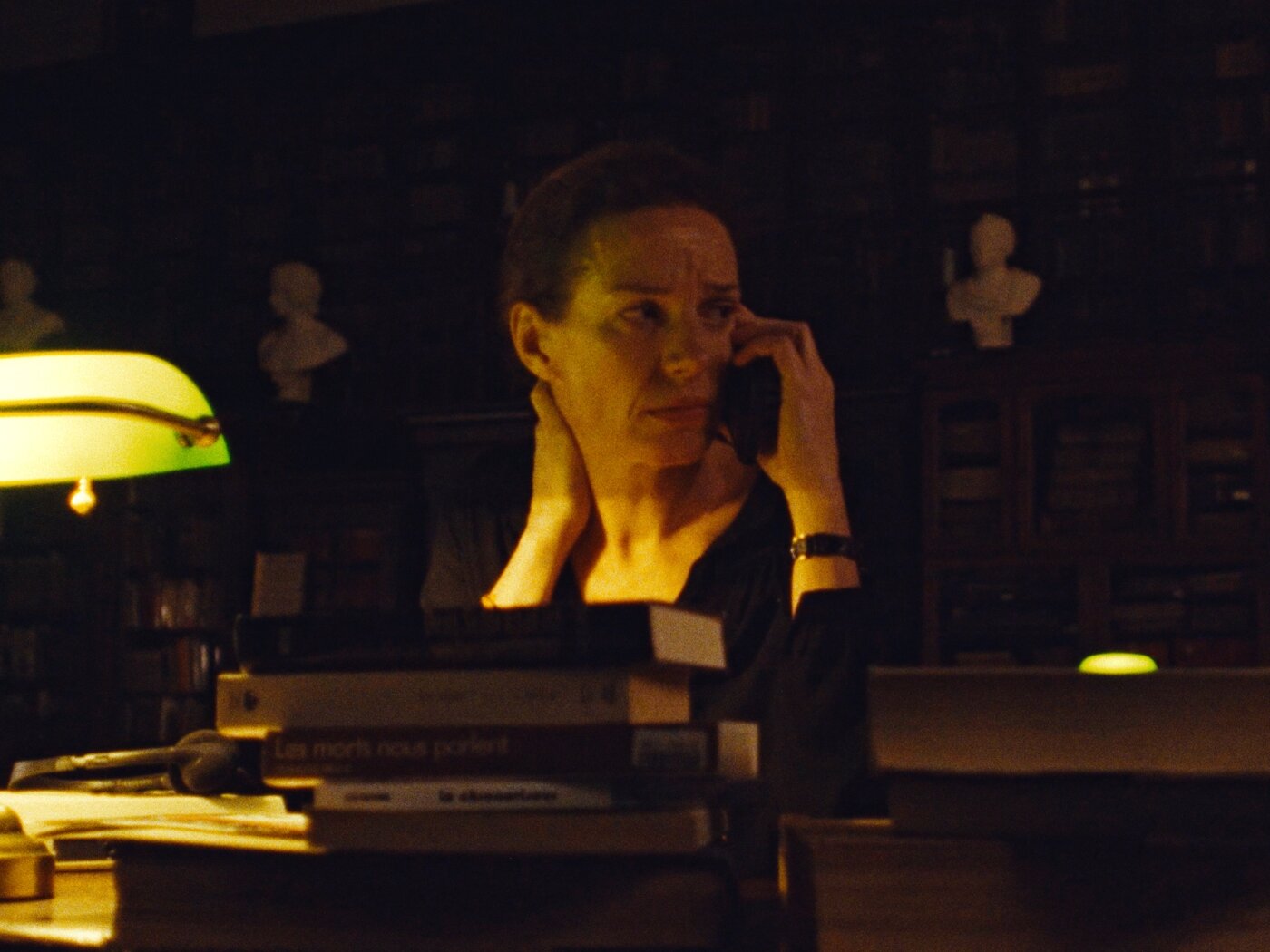
At the International Film Festival Rotterdam, audiences encountered Chronovisor as a work of high-concept fiction that resists easy classification. Directed by Kevin Walker and Jack Auen, the film follows Beatrice — played by behavioral science professor Anne-Laure Sellier — as she navigates a labyrinthine research project involving a suppressed invention and a mysterious priest. The central conceit, which sounds like the product of a speculative writers' room, is rooted in a bizarre and largely forgotten corner of 20th-century history: the claim by a Benedictine monk that he had built a machine capable of viewing the past.
The titular device was the alleged creation of Father Pellegrino Ernetti, a Benedictine monk and physicist based in Venice who, beginning in the late 1950s, claimed to have developed a way to capture "electromagnetic remnants" of past events. Ernetti's Chronovisor was not a time machine in the physical sense but a receiver — one that purportedly translated historical waveforms into a visual medium, effectively turning the past into a crude, flickering television broadcast. The story circulated in Italian media for decades, gaining a second life in Peter Krassa's 2000 book on the subject, and has since become a staple of fringe history and conspiracy lore. Walker and Auen's film treats this historical rabbit hole not merely as a plot point but as an inquiry into the act of reading and the preservation of memory.
The Archive as Thriller
The decision to cast a working academic rather than a professional actor in the lead role signals the film's broader ambitions. By placing Sellier — whose scholarly work concerns decision-making and cognition — at the center of the narrative, Walker and Auen collapse the distance between investigator and investigation. Beatrice is not performing research for dramatic effect; the character inhabits the rhythms of genuine scholarly obsession, the kind that turns footnotes into labyrinths and primary sources into objects of fixation.
Formally, the film blurs the line between a traditional thriller and an archival essay. It utilizes meticulously sourced primary documents, overlaying English translations directly onto multilingual texts, and incorporates unsettling footage of Ernetti's funeral. The effect is something closer to the documentary-fiction hybrids that have gained traction in festival circuits over the past decade — works that treat the apparatus of research itself as cinematic material. Films like those of Hito Steyerl or the essay-film tradition descending from Chris Marker have long explored the tension between the document and its interpretation. Chronovisor operates in adjacent territory, though its narrative scaffolding is more conventional, at least initially.
Dissolving the Frame
As the narrative progresses, the structure begins to dissolve. What starts as a character-driven study of obsession shifts into something closer to abstract video art. The film's formal disintegration mirrors the very device it describes: an attempt to reconstruct a coherent image from the fragmented waveforms of the past, an image that may never have been stable to begin with. The Chronovisor legend itself carries this same instability — Ernetti's claims were never verified, the Vatican never confirmed or denied the device's existence in any official capacity, and the single photograph Ernetti allegedly produced (a blurry image he attributed to Christ's crucifixion) was later linked to a wooden crucifix in a church in Perugia.
This is the tension the film leaves unresolved, and deliberately so. The archival thriller typically promises revelation — the document that proves the conspiracy, the testimony that closes the case. Chronovisor withholds that satisfaction. Its interest lies not in whether Ernetti's machine worked or whether the Vatican suppressed it, but in what it means to want such a device to exist in the first place. The desire to make the past visible, to convert memory into signal and signal into image, is not confined to fringe science. It is the foundational impulse of cinema itself.
Whether Chronovisor finds distribution beyond the festival circuit remains an open question. The film sits at an uncomfortable intersection — too essayistic for genre audiences, too narrative for the gallery circuit. But the space it occupies, between document and invention, between the archive and the screen, is precisely where some of the most compelling work in contemporary cinema is being made. The question is whether that space can sustain an audience or whether it remains, like Ernetti's machine, a transmission received by very few.
With reporting from MUBI Notebook.
Source · MUBI Notebook