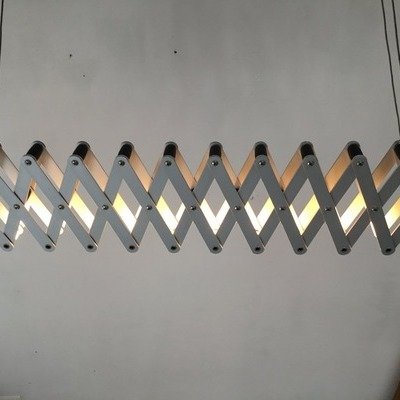
The transition from the 1970s to the 1980s marked one of the more decisive aesthetic ruptures in postwar design. Soft, biomorphic plastic forms — the legacy of Joe Colombo, Verner Panton, and the Italian radical design movement — gave way to a harder vocabulary: exposed fasteners, matte-black finishes, perforated steel, and a fascination with the visual language of engineering. Among the artifacts that crystallized this shift is the expanding "Architect's Lamp" by German lighting designer Oliver Michl, a ceiling-mounted fixture that treated a humble drafting tool as raw material for sculptural ambition.
Michl's lamp borrows its central mechanism from the equal space divider, a precision instrument used by cartographers and draftsmen to mark equidistant points along a line. The tool operates on a scissor-like accordion principle: a lattice of pivoting arms that expands and contracts uniformly. By scaling this mechanism up and mounting it overhead with a light source at its terminus, Michl produced a fixture that moves — literally — between compact rest and dramatic extension. The result is less household appliance than kinetic object, a piece that invites physical interaction in a way most ceiling lights never attempt.
The "High-Tech" Moment and Its Sources
Michl's lamp belongs to a broader design current that came to be known as "high-tech" — a term popularized in the late 1970s by Joan Kron and Suzanne Slesin's influential book of the same name. The movement drew on industrial and institutional objects — factory shelving, hospital carts, warehouse lighting — and recontextualized them as domestic furnishings. Designers and architects such as Richard Rogers and Norman Foster were pursuing a parallel logic in buildings, celebrating structure and services rather than concealing them behind plaster.
What distinguished the high-tech sensibility from mere industrial salvage was intentionality. Objects were not simply repurposed; their mechanical logic was foregrounded as an aesthetic virtue. The equal space divider, in Michl's hands, ceased to be a means to an end and became the end itself. The expanding lattice is the lamp's defining visual feature, not a hidden mechanism. Every pivot point, every rivet, is legible. This transparency of function — the idea that how something works should be visible and even beautiful — was central to the decade's design ethos.
From Tool to Theater
Despite its name, Michl's creation is an "architect's lamp" only in spirit. Traditional architect's lamps — the spring-arm task lights descended from George Carwardine's 1932 Anglepoise — are deskbound, utilitarian, and defined by their adjustability in service of directed illumination. Michl's fixture inverts nearly every convention. It is ceiling-mounted rather than clamped to a surface. Its movement is theatrical rather than task-oriented. Its expanding form draws attention to itself rather than to the work beneath it.
This inversion is characteristic of a recurring pattern in design history: the moment when a functional typology is abstracted far enough from its origins to become a signifier rather than a tool. The drafting table's instruments — parallel rulers, compasses, adjustable arms — carried connotations of precision, intellect, and professional seriousness. Transplanted into a domestic lighting fixture, those connotations survived even as the original function disappeared. The lamp signals "design" without performing the task that inspired it.
Such objects occupy an ambiguous position. They are legible enough to evoke their source — anyone who has handled an expanding lattice tool recognizes the mechanism — yet detached enough to function as pure form. Whether that detachment represents design at its most inventive or its most self-referential depends on what one expects a lamp to do. If the answer is simply "illuminate," Michl's fixture is an elaborate digression. If the answer includes "provoke a second look at the mechanical world hiding in plain sight," the lamp earns its place on the ceiling.
The tension between those two expectations — utility and spectacle, tool and trophy — remains unresolved in Michl's design, and perhaps that is precisely what keeps it interesting four decades later.
With reporting from Core77.
Source · Core77