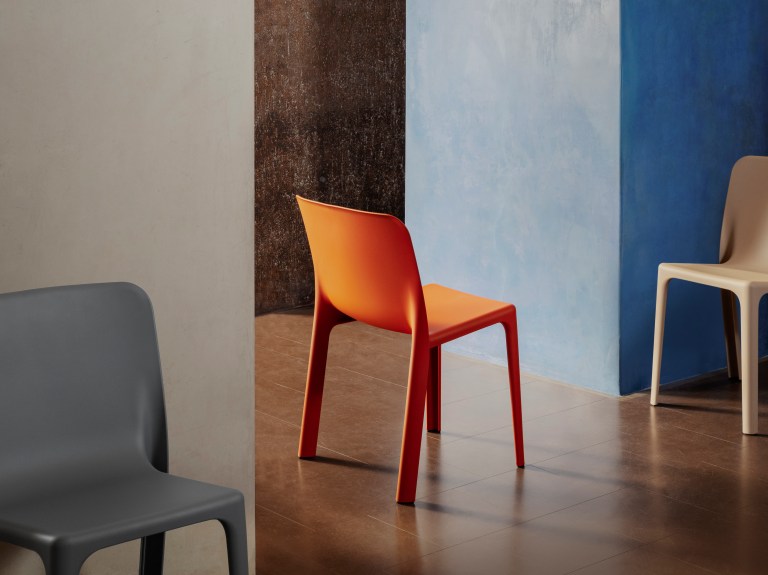
At Milan Design Week, the monobloc chair — a typology so ubiquitous it has become almost invisible — receives a studied reconsideration. Linnéa, the latest collaboration between designer Luca Nichetto's studio NICHETTO and the manufacturer infiniti, debuted at Salone del Mobile as an attempt to reconcile two forces that rarely coexist in furniture: the efficiency of high-volume industrial production and the emotional texture typically associated with limited-edition craft.
The chair's first unit was recently pulled from a steel mold at the OMP Group's facility near Treviso, in northeastern Italy. For infiniti, OMP's design-oriented brand, the project draws on four decades of expertise in plastics and steel manufacturing. For Nichetto, whose practice is known for embedding narrative into functional objects, Linnéa is an exercise in what he frames as "material beauty" — the idea that an industrially produced piece can carry visual and tactile resonance without sacrificing its practical purpose.
The monobloc's long shadow
Few objects in design history carry as much cultural baggage as the monobloc chair. The single-piece injection-molded plastic seat, produced in the hundreds of millions since the mid-twentieth century, became a global default: cheap, stackable, indifferent to context. It appears on sidewalks in Lagos, balconies in Naples, and food courts in São Paulo. Its very success made it a symbol of disposability — functional but devoid of intention beyond cost reduction.
That reputation has made the monobloc a recurring challenge for designers seeking to prove that industrial scale and aesthetic ambition are not mutually exclusive. Attempts to rehabilitate the form have surfaced periodically, from Vitra's collaborations with established designers to Magis's experiments in gas-assisted injection molding. The underlying question remains consistent: can a chair produced in the thousands carry the same design conviction as one produced in the dozens?
Linnéa enters this lineage with a specific proposition. Rather than treating industrial constraint as a limitation to be masked, the collaboration between NICHETTO and infiniti treats it as a generative framework. The chair is shaped by what the factory floor can achieve — the tolerances of the mold, the flow characteristics of the material, the economics of the production run — and the design responds to those parameters rather than fighting them.
Craft logic at industrial scale
The partnership reflects a broader current in contemporary furniture design: a move away from purely speculative or exhibition-driven work toward projects rooted in manufacturing reality. This approach — what the collaborators describe as a "feet-on-the-ground" work ethic — positions the designer not as an external author handing off a sketch, but as a participant embedded in the production process itself.
For the contract and residential markets, this integration matters. Furniture specified for hospitality, offices, and public spaces must meet durability, cost, and volume requirements that gallery pieces do not. The challenge lies in meeting those requirements without defaulting to the anonymous functionality that defines most contract seating. Linnéa's ambition is to occupy the space between — legible as a designed object, viable as a production one.
The broader tension is familiar but unresolved. Democratizing sophisticated aesthetics through industrial manufacturing has been a stated goal of the design discipline since at least the Bauhaus era. Each generation of materials, tooling, and production technology reopens the question of how far that democratization can extend before the economics of scale flatten the very qualities that distinguish a designed object from a commodity. Whether Linnéa navigates that tension successfully will depend less on its reception in Milan's temporary exhibitions and more on how it performs in the catalog — ordered in volume, placed in rooms where no one reads the designer's name, and judged by whether it holds attention anyway.
With reporting from Cool Hunting.
Source · Cool Hunting