The traditional mop and bucket is a study in diminishing returns. As the task progresses, the cleaning solution becomes an increasingly gray slurry of the very debris it is meant to remove. To clean the floor, the user must repeatedly submerge the mop into this contaminated reservoir, effectively spreading diluted grime across the surface rather than lifting it away. It is a problem so familiar that most users have stopped recognizing it as a design failure at all.
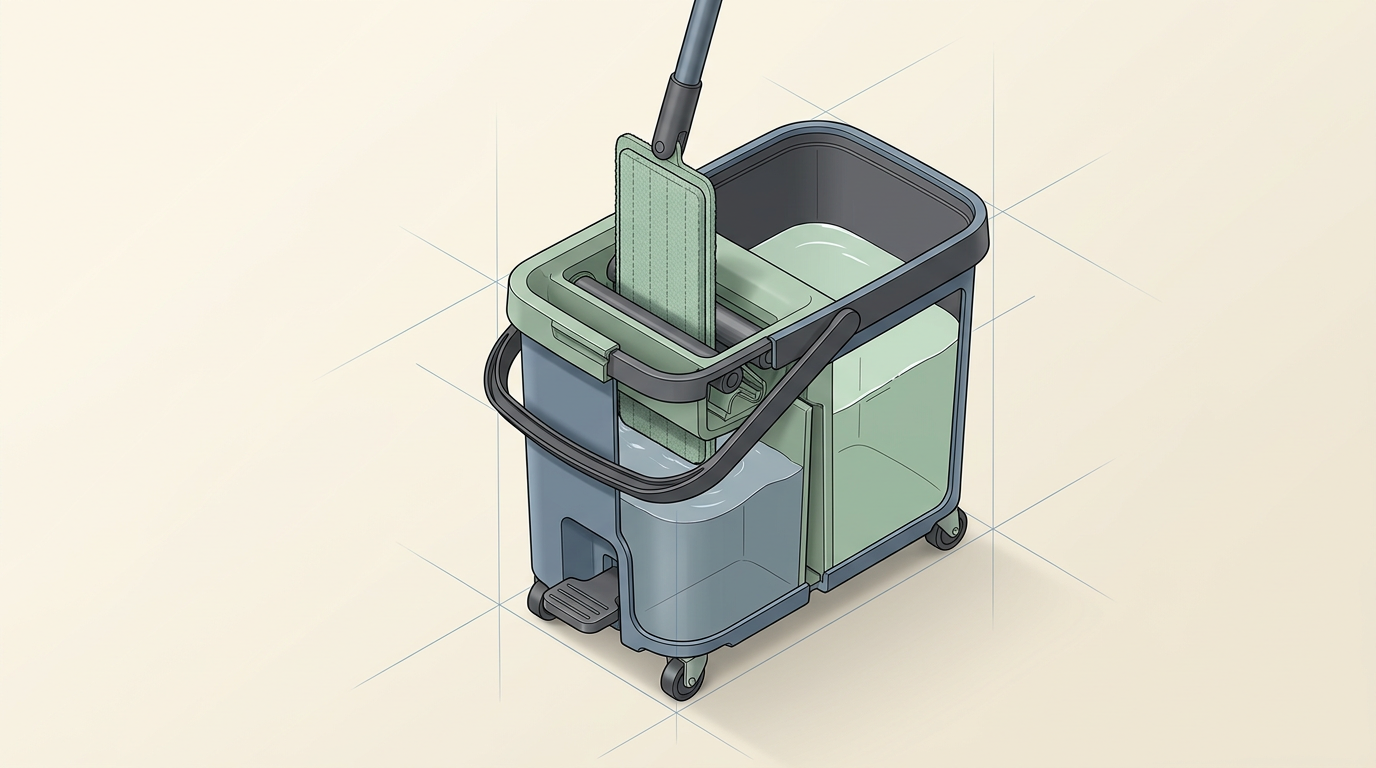
Joseph Joseph, a British firm that has built its reputation on applying rigorous industrial design to domestic inconveniences, has attempted to break this feedback loop with its new UltraClean system. The design replaces the single, open bucket with a dual-chambered architecture that isolates the clean water supply from the waste.
A Mechanical Solution to a Behavioral Problem
The core insight behind the UltraClean system is that the conventional mop-and-bucket arrangement conflates two distinct functions — dispensing clean solution and receiving dirty runoff — into a single vessel. Every competing mop design that has tried to address floor hygiene has generally done so by changing the mop head material, adding microfiber pads, or introducing spray mechanisms that bypass the bucket entirely. Joseph Joseph's approach is different: it keeps the bucket but redesigns its internal logic.
The system's efficiency relies on a mechanical spray-and-scrape interface. When the mop is inserted into the bucket, it is rinsed with fresh water while a scraper removes trapped dirt and excess moisture. This runoff is diverted into a separate bin, ensuring that the mop head remains genuinely clean for every pass. The user never dips the mop into its own waste. The separation is physical and absolute, not dependent on filters or user discipline.
This kind of functional partitioning has precedents in other domains of product design. Commercial cleaning equipment — the kind used in hospitals and food service — has long employed dual-bucket or even triple-bucket systems to meet hygiene standards. What Joseph Joseph has done is compress that institutional logic into a form factor suited to a household closet. The translation from professional to domestic context is where much of the design challenge lies: the system must be compact enough to store, simple enough to operate without training, and affordable enough to justify replacing a product that costs very little.
Why Mop Design Resists Change
The mop is one of the most stubbornly static artifacts in the home. Its basic form — an absorbent head on a stick, paired with a water-filled container — has persisted for well over a century. Part of the reason is economic: mops are cheap, and consumers tend to treat them as disposable rather than as tools worth investing in. Another part is perceptual. Because mopping is a low-status chore, it attracts less design attention than cooking, sleeping, or even doing laundry, all of which have seen significant product innovation in recent decades.
Joseph Joseph has made a career of identifying precisely these overlooked categories. The company's catalog — spanning kitchen utensils, waste bins, and bathroom accessories — follows a consistent pattern: take a mundane household object, identify the specific friction point that users have normalized, and resolve it through form and mechanism rather than electronics or software. The UltraClean system fits squarely within that playbook.
Whether the market responds depends on a tension that runs through all premium household goods. Consumers generally acknowledge that better-designed tools improve the experience of domestic work, yet the willingness to pay a meaningful premium for a mop remains untested territory for most households. The gap between recognizing a design problem and paying to solve it is where products like the UltraClean will succeed or stall. Joseph Joseph is betting that hygiene — the promise that the floor is actually clean, not just wet — is a strong enough value proposition to close that gap.
With reporting from Core77.
Source · Core77