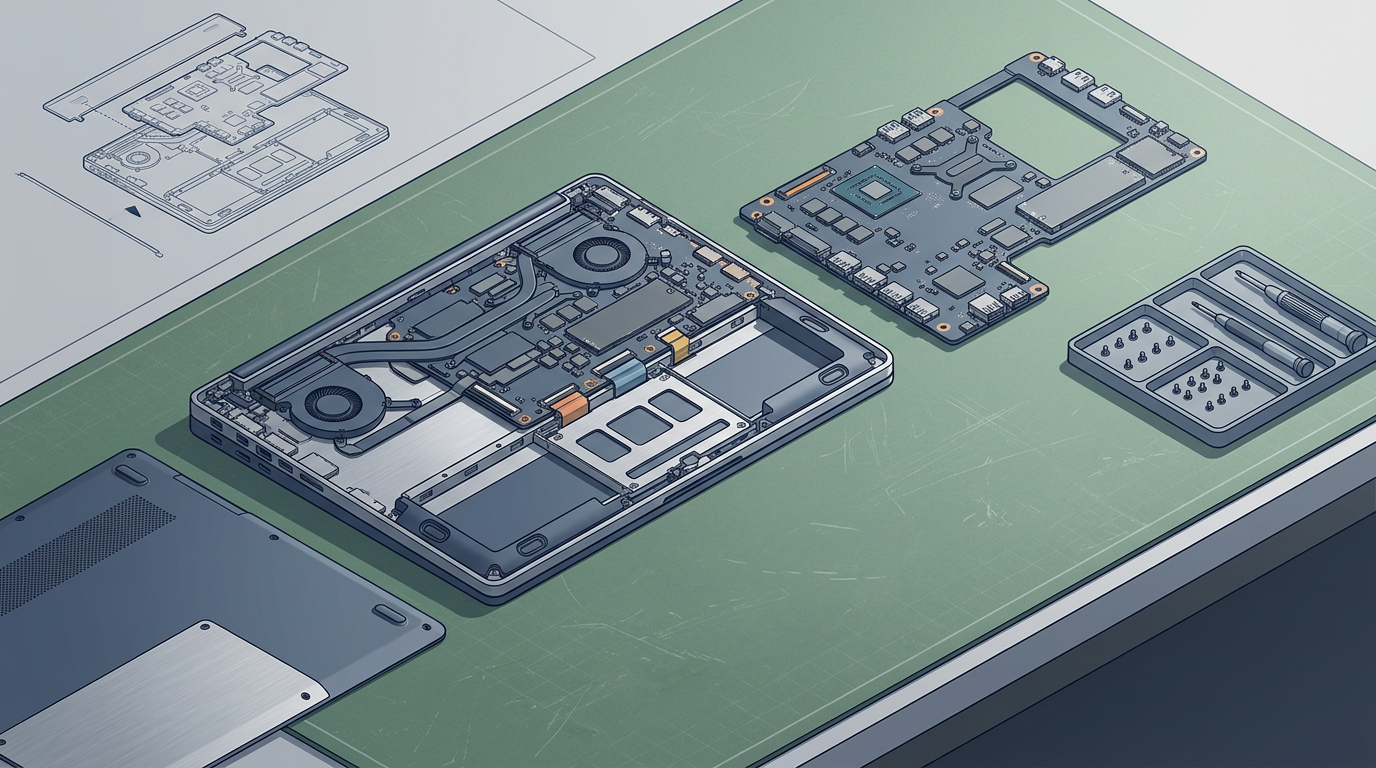
Framework, the Portland-based startup that reimagined the laptop as a modular assembly of swappable components, is sharpening its focus. The company's latest hardware cycle introduces the Framework Laptop 13 Pro, built around Intel's Core Ultra Series 3 processors. The internal specifications represent a generational step forward, but the delivery mechanism remains the more consequential story: the new motherboard is backward-compatible with existing Framework chassis, allowing current owners to upgrade by replacing a single component rather than purchasing an entirely new machine.
The release also marks a deliberate strategic turn toward the Linux professional market. CEO Nirav Patel has framed the Laptop 13 Pro as a "MacBook Pro for Linux users"—a direct appeal to a demographic that has long occupied an awkward middle ground between underpowered hardware certified for open-source operating systems and the polished but closed ecosystem of Apple's machines. To substantiate the comparison, Framework has secured its first official Ubuntu certification and will offer factory-installed Linux for the first time, moving beyond the "bring your own OS" model that characterized its earlier product cycles.
Repairability as Professional Infrastructure
The right-to-repair movement has, for most of its public life, been framed as a consumer advocacy issue—a matter of principle for hobbyists and environmentalists. Framework's latest move reframes it as a professional infrastructure question. For developers, data scientists, and system administrators who depend on Linux as a daily working environment, hardware longevity is not an ideological preference but a practical requirement. Rebuilding a development environment on a new machine carries real costs in time and configuration drift.
By designing motherboard upgrades as a routine maintenance task rather than a trigger for full device replacement, Framework is making an implicit argument: that the professional laptop should function more like a workstation, where individual components are refreshed on independent timelines. This stands in contrast to the prevailing industry model, in which tightly integrated designs—soldered RAM, glued-in batteries, proprietary storage—compress the useful life of a device and push users toward shorter replacement cycles. Apple's MacBook Pro line, the very product Framework is positioning against, exemplifies this approach. Its machines are widely regarded as excellent tools, but their repairability scores remain low, and component-level upgrades are effectively impossible for end users.
The tactile improvements in this cycle—better displays and refined keyboards addressing long-standing community feedback—are incremental but meaningful in context. Professional users who spend eight or more hours a day on a keyboard tend to weigh input quality heavily, and Framework's willingness to iterate on these elements based on direct user feedback signals a product development loop that most hardware manufacturers, constrained by longer design cycles and broader market targets, struggle to replicate.
The Linux Certification Gap
Ubuntu certification may sound like a minor checkbox, but it addresses a persistent friction point in the Linux hardware landscape. Canonical's certification program tests suspend and resume behavior, Wi-Fi and Bluetooth reliability, audio routing, and peripheral compatibility—the mundane failures that erode trust in a daily-use machine. Historically, only a handful of vendors, most notably Dell with its XPS Developer Edition and Lenovo with select ThinkPad models, have pursued this certification for consumer-grade laptops. The pool of options has remained small relative to the size of the professional Linux user base.
Framework's entry into this space carries an additional dimension. Because its hardware is modular, certification must account for a wider matrix of possible configurations—different expansion cards, storage modules, and memory arrangements. How Canonical and Framework manage that complexity over time will be worth watching. A certification that holds across multiple hardware generations and user-configured permutations would represent something genuinely new. A certification that quietly narrows the supported configuration space would undercut the modularity promise.
The broader tension Framework navigates is familiar to any company attempting to serve a niche with conviction while scaling toward financial sustainability. The Linux professional market is loyal but not large by consumer electronics standards. Patel's MacBook Pro comparison is aspirational—Apple's installed base and supply chain advantages are not easily matched. But the comparison also reveals the gap Framework is targeting: a segment of professionals who want premium build quality, long-term hardware investment, and an operating system they control, and who currently have few options that deliver all three without compromise.
Whether that segment is large enough to sustain a hardware company through multiple product generations remains the open question. The repairability thesis is elegant. The Linux certification is overdue. The market's willingness to reward both, at a price point that keeps Framework solvent, is the variable that no product announcement can resolve.
With reporting from Ars Technica.
Source · Ars Technica