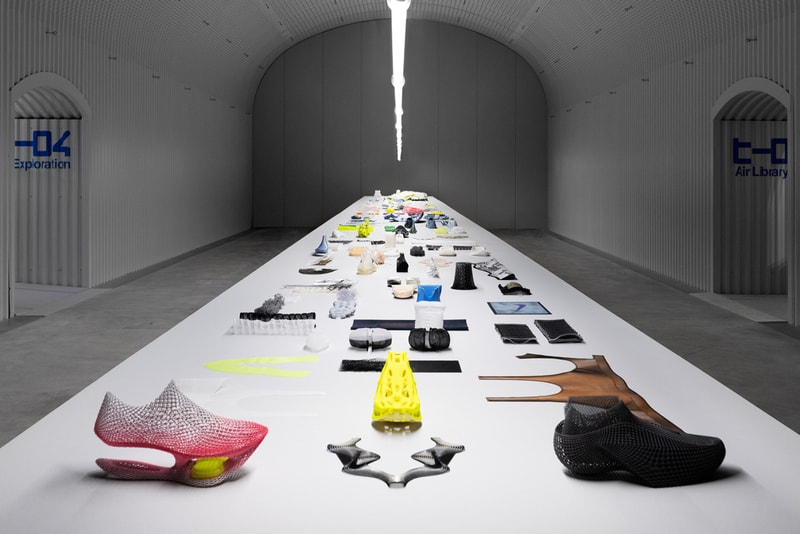
At Milan Design Week 2026, Nike has moved beyond the traditional retail footprint to establish a technical outpost that is part archive and part laboratory. Occupying Dropcity, Milan's architecture and design center, the "Air Lab" repositions the brand's long-standing obsession with pressurized gas as a rigorous exercise in industrial design. It is a space that treats the sneaker not merely as apparel, but as a complex assembly of material science.
The center of the exhibition is a library of more than 100 prototypes, many of which have never been seen by the public. These artifacts — ranging from the architectural foundations of the Air Max 1 to experimental concepts like "Air Liquid Max" and "FlyWeb" — trace a lineage of pneumatic engineering. By showcasing these iterations, Nike invites a more technical critique of footwear, highlighting the evolution of "air" from a simple cushioning element to a sophisticated structural medium.
From Cushioning to Canon
Nike's relationship with air as a functional material dates back to the late 1970s, when aerospace engineer Frank Rudy pitched the idea of gas-filled pouches embedded in shoe soles. The resulting Air technology debuted in the Tailwind in 1979 and became a commercial phenomenon with the Air Max 1 in 1987, which made the air unit visible through a window in the midsole. That decision — showing the consumer the mechanism itself — turned an engineering solution into a design language. Over the following decades, the platform expanded into variations like the Air Max 270, VaporMax, and the full-length Zoom Air units used in performance running.
What the Air Lab installation does is pull back the curtain further, presenting the failures, dead ends, and speculative branches that never reached production. In industrial design, the prototype archive is typically a closely guarded asset. Companies rarely exhibit what did not work, because the commercial logic favors finished narratives. Nike's willingness to display unreleased concepts such as "Air Liquid Max" and "FlyWeb" reframes the brand's innovation pipeline as an open research program rather than a marketing sequence. The gesture carries strategic weight: it positions Nike not as a fashion house that happens to engineer shoes, but as a materials company that happens to operate in fashion.
Visitors are encouraged to engage with this medium through eight specialized tool stations. These modules utilize robotic arms, thermoforming machines, and pneumatic cylinders to explore the lifecycle of a design: from visualization and formation to the purposeful deformation of shapes under pressure. The inclusion of robotic fabrication tools signals an alignment with broader trends in computational design, where parametric modeling and automated production are collapsing the distance between concept and physical object.
Design Week as R&D Theater
Milan Design Week has long served as a stage where brands from adjacent industries — automotive, technology, luxury — present conceptual work that would be out of place in a showroom or trade fair. Nike's presence at Dropcity fits a pattern established by companies like Google, IKEA, and various automotive manufacturers, which have used the Salone and its satellite events to test ideas in front of a design-literate audience rather than a consumer one. The calculation is specific: feedback from architects, industrial designers, and material scientists carries different value than retail data.
The decision to make the Air Lab a permanent installation at Dropcity beginning this fall adds another dimension. A temporary exhibition signals cultural participation; a permanent one signals institutional ambition. Nike would effectively maintain a standing research presence inside one of Europe's primary design venues, blurring the line between corporate showroom and public design archive.
While the lab includes lifestyle elements like breathwork sessions and listening parties, its primary function is a disciplined look at how a brand can iterate on a single, invisible element for decades. Whether the installation ultimately serves Nike's innovation culture or its brand mythology — or whether those two objectives can even be separated at this scale — is a tension the audience at Dropcity is well-equipped to evaluate for themselves.
With reporting from Hypebeast.
Source · Hypebeast