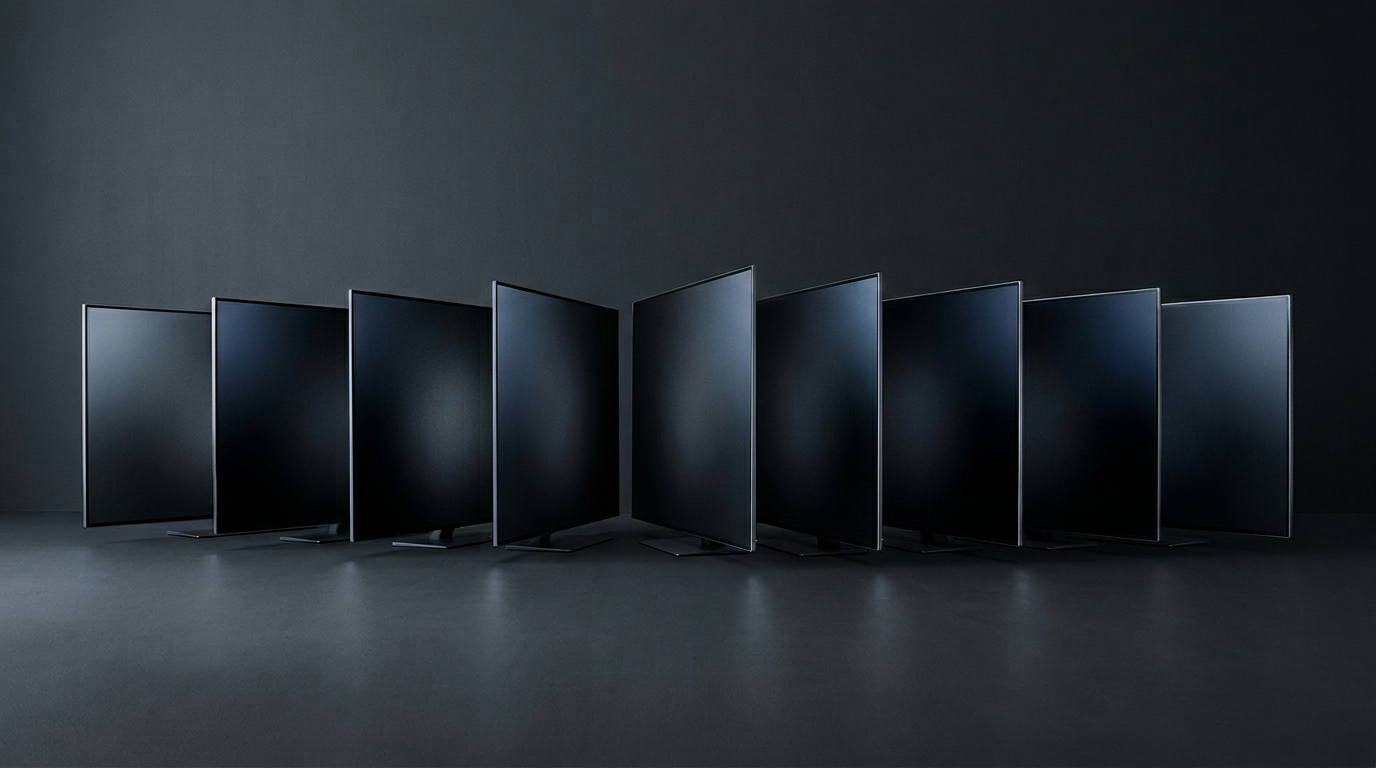
The 4K television has completed a familiar arc in consumer electronics: from aspirational luxury to unremarkable default. Across major retail markets, high-resolution panels now occupy the same commodity shelf space that 1080p sets held a few years ago. The shift has been swift enough that manufacturers face a structural problem — when every set on the showroom floor offers the same resolution, the pixel count itself ceases to be a selling point.
Recent product lineups from Samsung, LG, Philips, and TCL reflect the industry's response to that problem. Rather than pushing resolution further upward (8K adoption remains marginal, constrained by content scarcity and diminishing perceptual returns at typical viewing distances), manufacturers are competing on two fronts that sit behind the glass: AI-driven image processing and the software ecosystem that governs the user experience.
The Upscaling Arms Race
The logic behind AI upscaling is straightforward. The vast majority of content consumed on a 4K panel — broadcast television, older streaming catalogs, user-generated video — was not produced in native 4K. The television's processor must therefore interpolate, filling in detail that the source material never contained. Samsung's Crystal UHD series leans on proprietary upscaling algorithms to bridge this gap, while LG's mid-range sets deploy the α7 AI processor to sharpen and denoise lower-resolution feeds in real time.
This is not a new concept. Upscaling has existed in some form since the early days of HD. What has changed is the sophistication of the approach and, critically, its marketing prominence. Where panel technology — OLED versus QLED versus standard LED — once dominated product differentiation, the conversation has migrated toward the chip inside the set and the neural-network models it runs. TCL's QLED offerings, for instance, compete less on the quantum-dot layer itself than on the processing pipeline that sits behind it.
The result is a market where the hardware's primary job is remediation: correcting, enhancing, and reconstructing content that was never designed for the display rendering it. Whether this constitutes genuine image quality improvement or sophisticated approximation remains a matter of engineering nuance that most consumers will never interrogate — they will simply notice that the picture looks sharper.
The Television as Platform
The second axis of competition is arguably more consequential in the long term. With operating systems like Samsung's Tizen, LG's WebOS, and Google TV embedded across product lines, the modern television functions less as a display and more as a platform. It aggregates streaming services, manages smart home devices, and serves as an interface for voice assistants. The purchase decision increasingly resembles a smartphone platform choice: not which screen looks best, but which ecosystem the buyer is willing to inhabit.
This platform dynamic carries familiar strategic implications. Lock-in effects grow as users accumulate purchased content, configured routines, and connected devices within a single ecosystem. For manufacturers, the recurring revenue potential of advertising and app-store commissions on a smart TV platform can rival or exceed the margin on the hardware itself — a model that echoes the economics of game consoles and mobile operating systems.
The standardization of 4K, then, has not flattened the competitive landscape so much as relocated it. The battleground has moved from the panel to the processor and from the display to the operating system. For consumers, the question is no longer whether to buy a 4K television — that decision has been made for them by the market — but which layer of invisible software they trust to sit between them and their content. Whether AI upscaling and ecosystem integration represent genuine value or incremental differentiation dressed in new language is a tension the market has yet to resolve.
With reporting from Olhar Digital.
Source · Olhar Digital