The Nike Air Max 95 has long served as a platform for the brand's most enduring color experiments, moving beyond its performance roots to become a staple of urban design. The upcoming revival of the "Green Apple" colorway — a 2010 release that was originally a regional exclusive — marks a return to the high-contrast, neon-inflected palettes that defined the silhouette's early-aughts resurgence. For a sneaker that debuted in 1995 as a running shoe inspired by human anatomy, the Air Max 95 has proven remarkably durable as a cultural object, one whose relevance is renewed each time Nike reaches back into its archive.
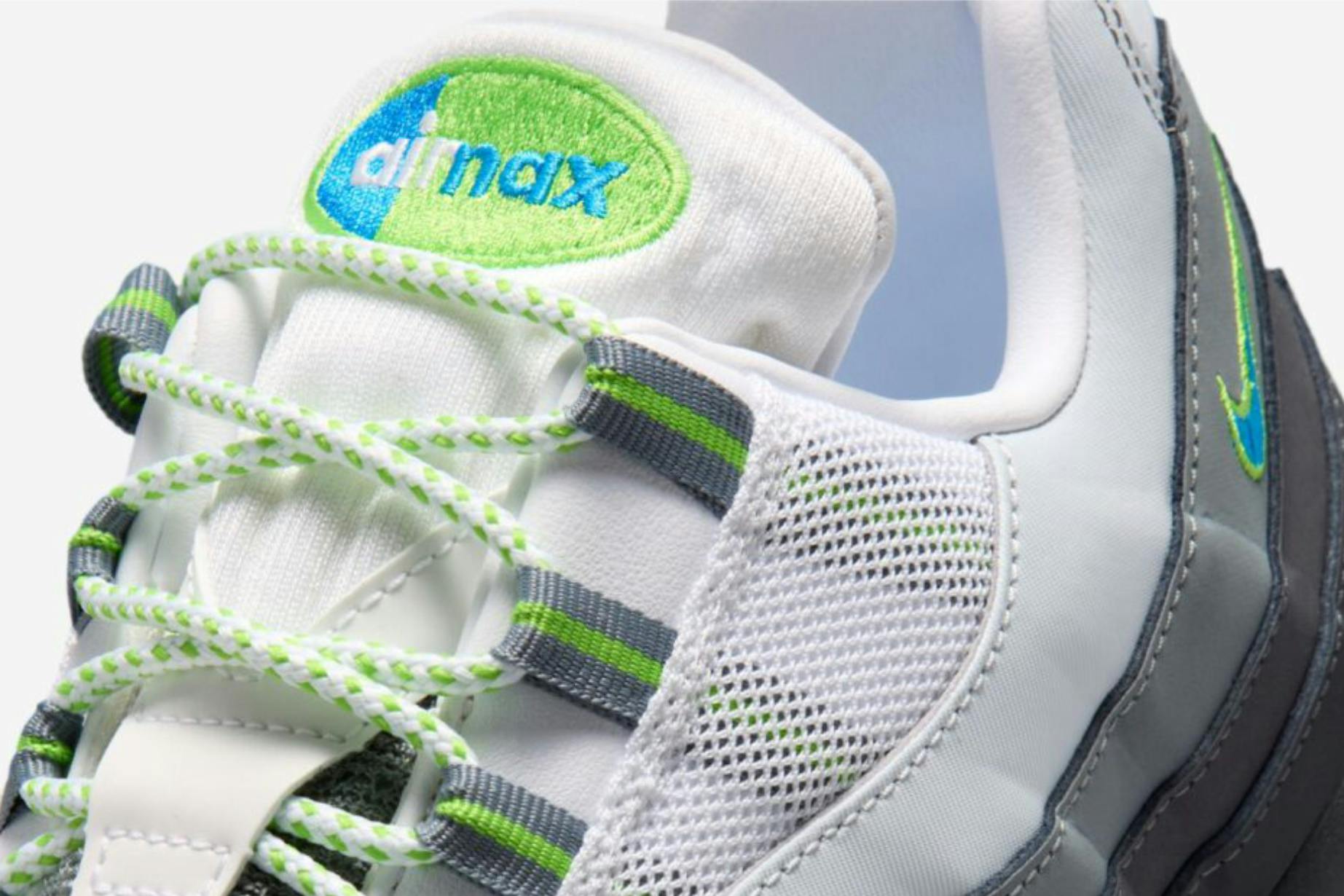
The original "Green Apple" earned a quiet following when it launched over a decade ago, in part because its limited regional distribution kept supply scarce and demand persistent. The colorway paired the model's signature graduated grey panels — designed by Sergio Lozano to evoke layers of muscle and skin — with sharp neon green accents that gave the shoe a tart, almost electric presence on foot. It was a release that resonated with collectors who prized the Air Max 95 not for hype cycles but for its design grammar: the interplay of muted tones and sudden bursts of color.
Archival revival as product strategy
The new iteration maintains the "sour-sweet" green accents and grey gradient of the original but incorporates subtle structural updates. Most notable is the inclusion of larger Air units within the midsole, a technical refinement that aligns the retro design with modern cushioning standards. It is a move that balances the preservation of a cult favorite with the incremental evolution of footwear engineering — a tension that defines much of the contemporary retro sneaker market.
This approach is not unique to the "Green Apple." Nike has spent years refining a playbook in which archival colorways are reissued with just enough technical improvement to justify a new production run without alienating purists. The strategy treats the back catalog less as a museum and more as a living inventory, where dormant assets can be reactivated when market conditions or cultural timing align. Adidas has pursued a similar logic with its own heritage models, and New Balance's recent commercial resurgence owes much to the same principle: that nostalgia, when paired with product credibility, converts reliably into demand.
The "Green Apple" also arrives within a broader thematic pattern in Nike's recent Air Max 95 output. Food-inspired colorways — including iterations dubbed "Hot Curry" and "Butter" — suggest a deliberate editorial coherence, as if the brand is curating seasonal collections around sensory reference points rather than releasing colorways in isolation. Whether this reflects a centralized creative direction or simply a trend among the design teams responsible for the silhouette, the effect is a product line that reads as more intentional than the scattershot approach that characterized earlier eras of retro releases.
The economics of scarcity and reach
It remains unclear whether the "Green Apple" will stay a limited boutique exclusive or receive a broader global rollout. That distinction matters. Limited releases generate outsized cultural attention relative to their revenue contribution, functioning as marketing instruments that sustain a model's perceived desirability. Wider releases, by contrast, capture more direct revenue but risk diluting the sense of exclusivity that keeps collector communities engaged. Nike has historically toggled between these modes with the Air Max 95, sometimes flooding the market and sometimes pulling back — a calibration that reflects shifting inventory priorities as much as brand strategy.
The return of the "Green Apple" underscores the cyclical nature of sneaker culture, where a regional exclusive from 2010 can re-enter the conversation with renewed relevance. But it also raises a question that applies well beyond a single colorway: how many times can a brand revisit its own archive before the archival pull weakens? The Air Max 95 has sustained three decades of reissues, collaborations, and reinterpretations. Whether that longevity reflects the enduring strength of the original design or simply the absence of a successor with comparable cultural weight is a tension Nike has yet to resolve — and may not need to, so long as colorways like the "Green Apple" keep finding an audience.
With reporting from Highsnobiety.
Source · Highsnobiety