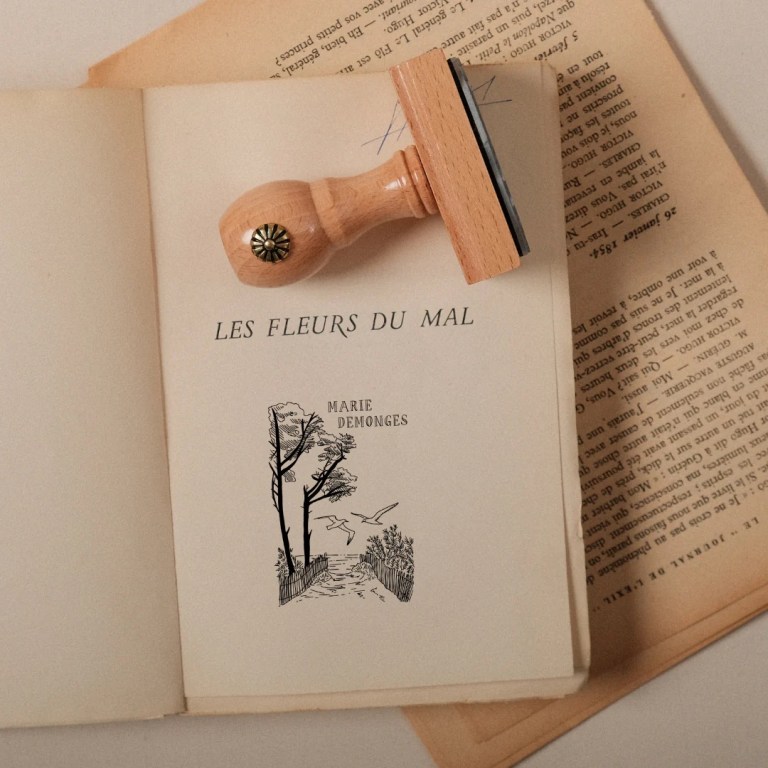
In the digital era, where personal libraries are often reduced to cloud-based lists and e-reader catalogs, the physical book has transitioned from a mere information carrier to a cherished artifact. Marking one's territory within these bound volumes is a tradition dating back centuries — yet a Paris-based studio called Exlibris Paris is modernizing the practice for a generation that values tactile exclusivity. Founded by Lauren and Igor, the studio offers a contemporary take on the ex libris — the bookplate — through meticulously crafted stamps that blend historical ownership markers with modern artisanal design.
The concept is deceptively simple: a rubber stamp, pressed inside a book's front cover, declares the volume part of a personal collection. But the ex libris carries far more cultural weight than its modest footprint suggests.
A tradition older than the printing press
The practice of marking book ownership predates Gutenberg. Medieval monasteries inscribed manuscripts with ownership notes to track volumes across scriptoria and lending networks. By the fifteenth century, as printed books became more widely available, European collectors began commissioning engraved or woodcut bookplates — small printed labels pasted inside a cover, typically bearing a coat of arms, a motto, or an allegorical scene. Albrecht Dürer is known to have designed bookplates for patrons. Over the following centuries, the ex libris became a minor art form in its own right, with dedicated collectors and periodic exhibitions.
The tradition faded through the twentieth century as mass-market publishing made books less precious in the popular imagination and as photocopied lending stickers replaced personalized marks. What Exlibris Paris proposes is not so much an invention as a recovery — repositioning the bookplate as a deliberate aesthetic choice rather than an aristocratic formality.
Scarcity, craft, and the economics of personal identity
The studio's offerings are divided between limited-edition designs and bespoke commissions. The former, priced at approximately $112, are produced in runs of just 12, ensuring that the mark inside a reader's cover remains nearly as rare as the collection itself. These designs are frequently refreshed, leaning into a graphic sensibility that feels both archival and current. The constraint of a small edition run borrows a logic familiar from printmaking and streetwear alike: artificial scarcity as a guarantor of meaning.
For those seeking a more permanent signature, the custom service — starting at $291 — transforms personal photographs or thematic briefs into original illustrations. This process bridges the gap between traditional printmaking and personal branding, allowing collectors to anchor their libraries with a visual identity that is uniquely theirs.
The pricing positions Exlibris Paris squarely within the broader market for artisanal stationery and bookish accessories that has expanded alongside the resurgence of independent bookstores and analog culture. The appeal is not purely functional. A stamp does not prevent a book from being lost or borrowed indefinitely. Its value is symbolic — a declaration that the owner's relationship to a book is specific, intentional, and worth marking.
There is a broader design tension at work here. The contemporary interest in personalization often manifests through digital tools — custom playlists, algorithmic recommendations, monogrammed phone cases ordered through apps. Exlibris Paris moves in the opposite direction, requiring a physical act of impression each time a book enters the collection. The ritual is part of the product. In that sense, the studio sits at an intersection that several small-batch design firms now occupy: selling not just an object but a practice, a reason to slow down.
Whether the revived ex libris remains a niche enthusiasm among design-conscious bibliophiles or signals a wider appetite for analog identity markers in an increasingly dematerialized culture is an open question. The forces pulling in both directions — convenience and ephemerality on one side, permanence and craft on the other — show no sign of resolving. For now, Exlibris Paris has identified a narrow seam between nostalgia and utility, and pressed its stamp into it.
With reporting from Cool Hunting.
Source · Cool Hunting