Cosmotec, a Tokyo-based manufacturer specializing in industrial coated films for monitors and televisions, found itself at a crossroads following the 2008 financial crisis. As the market for display components shifted, the company sought to pivot from its traditional B2B foundations into the consumer space. The company partnered with Kenma, a Japanese industrial design firm, to find a new application for its specialized coating expertise. What emerged was not a digital product or a high-tech gadget, but a slap bracelet — one that may represent a case study in how material science, paired with careful ethnographic observation, can open entirely new product categories.
The breakthrough came not from a laboratory, but from a hospital ward. A Kenma designer observed a nurse so overwhelmed by the pace of her shift that she was scribbling vital notes directly onto the back of her hand. The image was striking not for its novelty but for its ubiquity: healthcare workers worldwide resort to the same improvised solution when the friction of pulling out a phone or finding a notepad exceeds the cognitive cost of simply writing on skin. This visceral display of need inspired a low-tech solution to a high-stakes problem — a wearable surface that could function as a portable, erasable whiteboard.
From Coated Film to Clinical Wearable
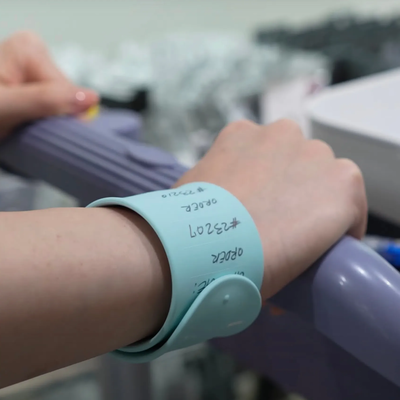
The resulting product, dubbed WeMo (short for "wearable memo"), is a wide slap bracelet treated with Cosmotec's proprietary film. Unlike standard plastics, the coating is designed to be written on with any oil-based ballpoint pen and remains waterproof — an essential feature for medical professionals who must wash their hands frequently. The notes remain legible through fluid exposure but can be erased with a simple rub of the finger, offering a tactile, immediate alternative to digital devices in environments where speed and hygiene are paramount.
The design logic behind WeMo inverts the dominant trajectory of healthcare technology. Where most innovation in clinical settings trends toward electronic health records, tablets, and voice-activated assistants, WeMo moves in the opposite direction. It acknowledges that in fast-paced, high-stress environments, the lowest-friction tool often wins. A nurse mid-procedure cannot unlock a screen. A pen and a wrist, however, are always available. The product does not compete with digital systems; it fills the gap that digital systems structurally cannot occupy — the seconds between observation and documentation.
The slap bracelet form factor itself carries a certain cultural resonance. Originally a novelty toy popularized in the late 1980s, the spring-steel band that curls around a wrist on contact has been repurposed over the decades for reflective safety bands and promotional merchandise. WeMo's adoption of the same mechanism is pragmatic rather than nostalgic: it allows one-handed application, stays secure during physical activity, and requires no clasp or adjustment.
Material Expertise as Strategic Pivot
For Cosmotec, WeMo represents something broader than a single product launch. The company's core competency — applying functional coatings to flexible substrates — had been built over years of supplying components to display manufacturers. The contraction of that market after 2008 forced a strategic question that many specialized B2B suppliers eventually face: whether the value of the company resides in the end market it serves or in the material capability it possesses. By partnering with Kenma, Cosmotec effectively chose the latter interpretation, treating its coating technology as a platform rather than a component.
This pattern has precedents across industrial history. Companies built around a single material or process — adhesives, polymers, optical coatings — have repeatedly found that their deepest competitive advantage transfers across categories, provided someone identifies the right application. The challenge is rarely technical. It is observational: finding the unmet need that maps onto an existing capability.
Kenma's role in that translation is worth noting. The ethnographic approach — embedding a designer in a clinical environment to watch workflows rather than solicit requirements — reflects a methodology that industrial design firms have long advocated but that remains underutilized in B2B product development. The nurse writing on her hand was not a user requesting a feature. She was a professional improvising under constraint. The distinction matters, because it suggests that the most productive design insights in specialized environments often come from watching what people do when they believe no one is designing for them.
Whether WeMo scales beyond its initial clinical niche or remains a narrow-use tool, the underlying tension it surfaces is durable: as digital systems grow more capable, the environments where they are least convenient — sterile, urgent, hands-occupied — grow more visible. The question is whether low-tech interventions like WeMo represent edge cases or a persistent counter-current in product design.
With reporting from Core77.
Source · Core77