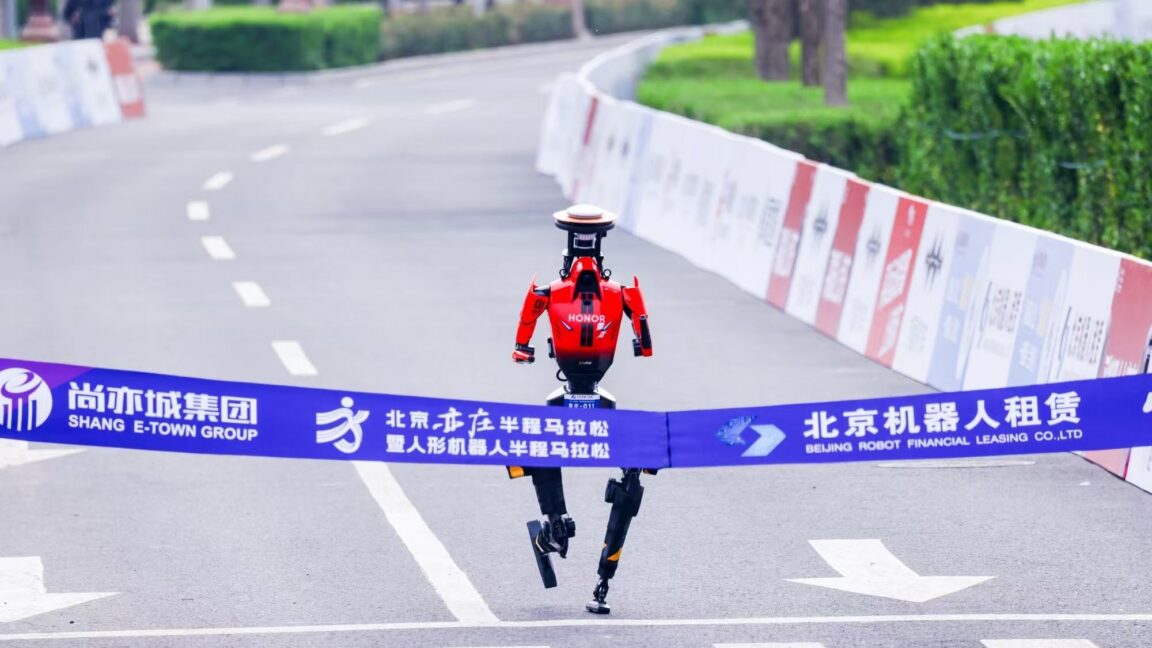
In a demonstration of how quickly the gap between biological and mechanical locomotion is closing, a humanoid robot recently completed a half-marathon in Beijing with a time that would leave the world's elite athletes in its wake. Developed by the Chinese electronics firm Honor, the machine navigated the 13-mile (21-kilometer) course autonomously in 50 minutes and 26 seconds. The feat comfortably eclipsed the human world record of 57 minutes and 20 seconds, held by Ugandan runner Jacob Kiplimo.
The robot's design is a study in biomimicry and hardware adaptation. To achieve its record-breaking pace, engineers equipped the machine with 37-inch legs, approximating the proportions of a long-distance runner. More critical, however, was the thermal management: a custom liquid-cooling system derived from Honor's smartphone architecture. This technology prevented the internal systems from seizing under the intense mechanical stress of a sustained, high-speed run — a challenge that has long limited the endurance of autonomous bipeds.
From spectacle to systems engineering
The half-marathon record is eye-catching, but the deeper significance lies in what it reveals about the state of bipedal robotics engineering. For decades, the central problem of humanoid locomotion has not been raw speed but sustained stability. Walking and running on two legs is an inherently unstable act — one that the human body manages through a dense feedback loop of proprioception, muscle co-contraction, and vestibular correction refined over millions of years of evolution. Replicating that loop in hardware and software has proven extraordinarily difficult.
Early humanoid platforms, such as Honda's ASIMO, could walk at modest speeds on flat surfaces but struggled with uneven terrain and could not sustain activity for extended periods without overheating or losing balance. Boston Dynamics' Atlas later demonstrated far more dynamic movement — jumping, spinning, recovering from pushes — but typically in short bursts under controlled conditions. A 21-kilometer autonomous run through a real urban course represents a qualitative shift: the problem being solved is no longer "can a robot walk" but "can a robot sustain complex locomotion at high output over meaningful distances without human intervention."
The thermal management angle is particularly telling. Overheating is one of the most persistent constraints on robotic endurance. Electric motors, actuators, and onboard processors all generate heat that compounds over time. Honor's decision to adapt liquid-cooling technology originally developed for consumer smartphones suggests a broader trend: the migration of thermal solutions across product categories, where expertise gained in one domain — compact, high-performance mobile devices — finds unexpected application in another.
The industrial horizon
Beyond the spectacle of the race, the event underscores China's aggressive scaling of humanoid robotics. The country has made the development of general-purpose humanoid robots a stated policy priority, with multiple firms and research institutions pursuing platforms intended for manufacturing, logistics, and hazardous-environment work. Honor is better known as a smartphone brand than a robotics company, which makes its entry into the field notable in itself — it signals that the enabling technologies for humanoid machines are becoming accessible enough for firms outside the traditional robotics sector to compete.
The Beijing run served as a high-profile test of speed and balance, but the underlying objective is the refinement of machines capable of operating in unstructured, real-world environments. Factories, warehouses, and construction sites do not offer the predictability of a laboratory floor. A robot that can maintain high-speed bipedal locomotion over a half-marathon distance without thermal failure is, implicitly, a robot moving closer to the endurance profile required for a full shift of industrial work.
The comparison to human performance, while vivid, carries its own asymmetry. The robot's 37-inch legs give it a stride advantage that no human runner possesses; its cooling system removes a biological constraint — sweating's limited throughput — that elite athletes must manage through hydration and pacing strategy. The machine did not beat Jacob Kiplimo on equal terms. It beat him by operating outside the constraints that define human physiology.
That asymmetry is precisely the point. The value of humanoid robots in industry will not come from mimicking human capability but from exceeding specific human limits — endurance, thermal tolerance, repetitive precision — while retaining the versatility of a human-shaped form factor that can navigate spaces designed for people. Whether the engineering demonstrated in Beijing translates from a road race to a factory floor remains an open question, one shaped by cost, reliability at scale, and regulatory frameworks that have yet to catch up with the hardware.
With reporting from Ars Technica.
Source · Ars Technica