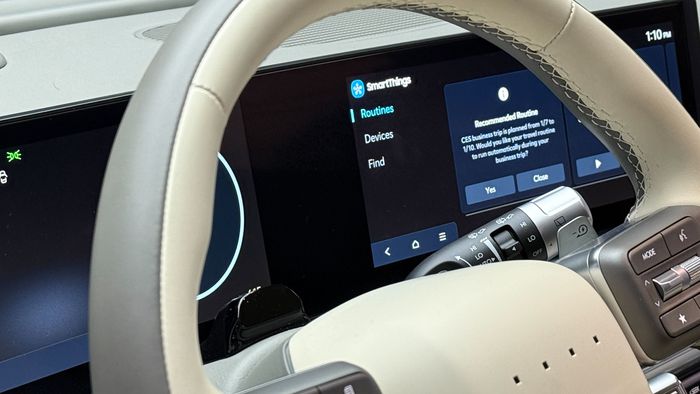
For nearly a decade, the automotive interior has been defined by a digital arms race. As manufacturers vied to replicate the seamless glass of a smartphone, physical buttons were relegated to the dustbin of design, replaced by expansive, high-resolution touchscreens that controlled everything from seat heaters to windshield wipers. However, at the 2026 New York Auto Show, Hyundai Motor North America signaled a decisive retreat from this "giant screen" era, arguing that the pursuit of digital minimalism has come at the cost of driver safety.
Olabisi Boyle, Senior Vice President at Hyundai, framed the shift as a necessary correction for the industry. The company's internal research suggests that the cognitive load required to navigate nested digital menus while driving creates dangerous distractions. By returning to tactile inputs—specifically for high-frequency functions like volume and climate control—Hyundai aims to reduce driver stress and allow for "eyes-on-the-road" operation that touchscreens simply cannot match.
A correction with precedent
Hyundai's move does not occur in a vacuum. The backlash against all-touchscreen interiors has been building for years across multiple fronts. Euro NCAP, the European safety assessment body, updated its protocols to penalize vehicles that bury essential controls—turn signals, hazard lights, windshield wipers—inside touchscreen menus. Mazda, long a holdout against the maximalist screen trend, has maintained a physical control knob as the centerpiece of its infotainment system, citing similar ergonomic reasoning. Volkswagen, after widespread criticism of the capacitive touch sliders introduced in its eighth-generation Golf, began reintroducing physical buttons in subsequent models.
The pattern is consistent: the industry's initial enthusiasm for large displays was driven partly by cost reduction—a single screen is cheaper to manufacture and update than a bespoke array of mechanical switches—and partly by consumer perception that digital interfaces signal technological sophistication. But the feedback loop between showroom appeal and real-world usability eventually produced friction. Drivers discovered that adjusting cabin temperature at highway speed through a sub-menu is not merely inconvenient; it is measurably slower and more distracting than reaching for a dedicated dial.
The physical manifestation of Hyundai's revised philosophy arrived in the form of the Boulder concept. Eschewing the industry's current obsession with monolithic dashboard displays, the Boulder features smaller, decentralized screens, each paired with dedicated physical knobs and switches. It is a design language that prioritizes ergonomics over aesthetic novelty, suggesting that the most sophisticated technology in a vehicle is often the one that doesn't require a glance to operate.
The competitive subtext
Hyundai's announcement also carries a pointed competitive dimension. The original reporting notes that the company's messaging implicitly targets Chinese automakers, many of which have leaned heavily into oversized, feature-rich displays as a core differentiator—particularly brands competing on technology spectacle in both domestic and export markets. By reframing large screens not as a mark of progress but as a potential liability, Hyundai is attempting to shift the terms of competition from screen size to interface quality.
This repositioning aligns with a broader strategic challenge facing legacy automakers. Chinese electric vehicle manufacturers have compressed development cycles and undercut incumbents on price and digital features. Competing on the same axis—more pixels, more diagonal inches—is a race that established players are unlikely to win on cost alone. Redefining the metric of interior quality around safety, tactile feedback, and cognitive ergonomics offers a different competitive narrative, one grounded in engineering discipline rather than spec-sheet maximalism.
Whether this narrative gains traction beyond a concept vehicle remains an open question. The Boulder is, for now, a statement of intent rather than a production commitment. Consumer preferences in key markets—particularly China and the United States—still skew toward large, visually striking displays. Regulatory pressure from bodies like Euro NCAP may accelerate the shift in Europe, but no equivalent mandate exists in North America. The tension, then, is between what safety research increasingly supports and what the showroom floor continues to reward. How quickly those two forces converge will determine whether Hyundai's tactile correction becomes an industry inflection point or remains a well-reasoned outlier.
With reporting from Canaltech.
Source · Canaltech