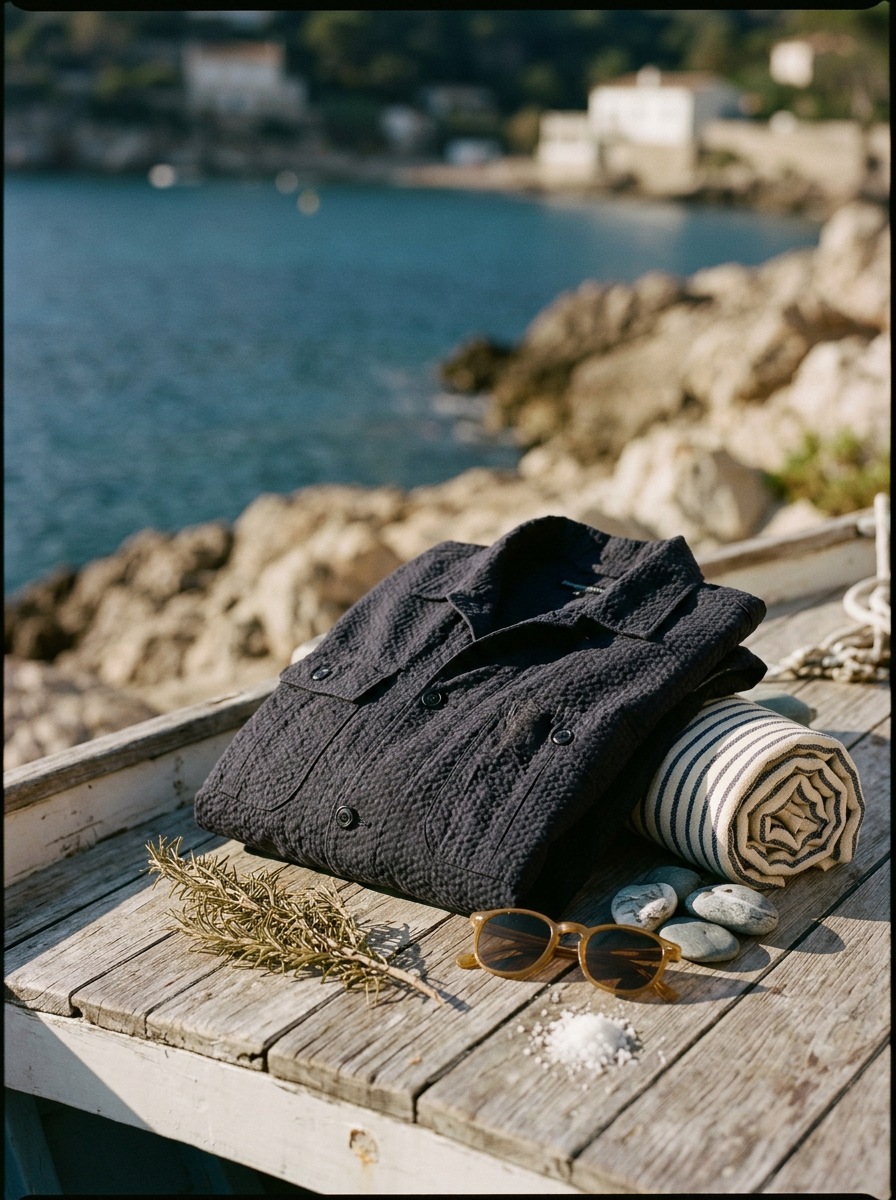
The second collaboration between Japanese retail giant GU and New York-based Engineered Garments arrives as an exercise in functional nostalgia. Titled "New American Riviera," the Spring/Summer 2026 capsule marks a return to the partnership between GU and designer Daiki Suzuki, whose work under the Nepenthes umbrella has long been defined by a meticulous, almost archival deconstruction of American workwear and military silhouettes. The six-piece lineup, rendered in a restrained palette of indigo and brown, draws its aesthetic cues from the relaxed elegance of 1950s resort wear while filtering those references through contemporary fabrication and climate-adaptive design.
The collection avoids the pitfalls of literal vintage reproduction. Suzuki reframes mid-century archetypes — the Guayabera shirt, the Cordlane jacket, utilitarian shorts — using updated proportions and materials engineered for breathability and movement. The garments are designed for the friction of modern urban life rather than the static leisure of a mid-century postcard, a distinction that separates the capsule from the wave of retro-inflected collections that have saturated the market in recent seasons.
Engineered Garments and the Architecture of Accessible Design
Daiki Suzuki founded Engineered Garments in 1999 as part of the Nepenthes ecosystem, a constellation of brands and retail operations rooted in a deep, almost scholarly engagement with American vernacular clothing. Over more than two decades, the label has built its reputation on a specific method: taking functional garments — military field jackets, postal uniforms, fishing vests — and reworking them with an attention to proportion, pocket placement, and fabric weight that elevates utility into something closer to design language. The brand occupies a particular position in menswear, respected by both the workwear-obsessed collector market and the broader fashion industry.
Partnering with GU places that sensibility inside a fundamentally different distribution model. GU, a subsidiary of Fast Retailing — the same parent company behind Uniqlo — operates as a high-volume, value-oriented retailer with significant reach across Asia. Where Engineered Garments typically sells through independent stockists and its own Nepenthes retail network at price points that reflect small-batch production, GU's infrastructure allows for scale. The collaboration, then, is not merely aesthetic. It is structural: a test of whether design thinking rooted in archival specificity can survive translation into mass-market retail without losing coherence.
This tension is not new in the industry. The history of designer-mass collaborations — from the early Target partnerships in the United States to Uniqlo's long-running series with designers like Jil Sander and Christophe Lemaire — has demonstrated both the commercial appetite for such projects and the difficulty of maintaining design integrity at volume. The most successful examples tend to involve designers whose work is already grounded in restraint and material logic rather than spectacle, which may explain why Suzuki's approach translates more naturally than most.
Climate-Adaptive Design as Quiet Infrastructure
The "New American Riviera" capsule also reflects a broader shift in how collections are conceived for physical comfort. The emphasis on climate-adaptive materials and breathability positions the garments within a growing category of clothing designed to perform in warming urban environments. This is not performance wear in the technical outdoor sense, but rather an acknowledgment that fabric choice and garment construction carry practical consequences for the wearer's daily experience.
The mid-century resort references serve a dual function here. On one level, they provide a visual vocabulary — relaxed shoulders, open collars, lighter-weight constructions — that signals ease. On another, they offer historical precedent: the original Riviera wardrobe was itself a response to climate, designed for Mediterranean heat before air conditioning rendered indoor temperature a non-variable. Suzuki's reinterpretation suggests that as outdoor heat becomes a more persistent factor in urban life, the logic of resort dressing may migrate from seasonal escapism to year-round necessity.
The question the collaboration leaves open is whether the model it represents — high-concept design distributed at accessible price points, with genuine attention to material performance — remains an exception or becomes a more durable template. The economics of fast retail typically reward speed and novelty over the kind of slow, reference-heavy design process that defines Engineered Garments. Whether GU's infrastructure can sustain that kind of partnership beyond occasional capsules may say more about the future of retail than the garments themselves.
With reporting from Hypebeast.
Source · Hypebeast