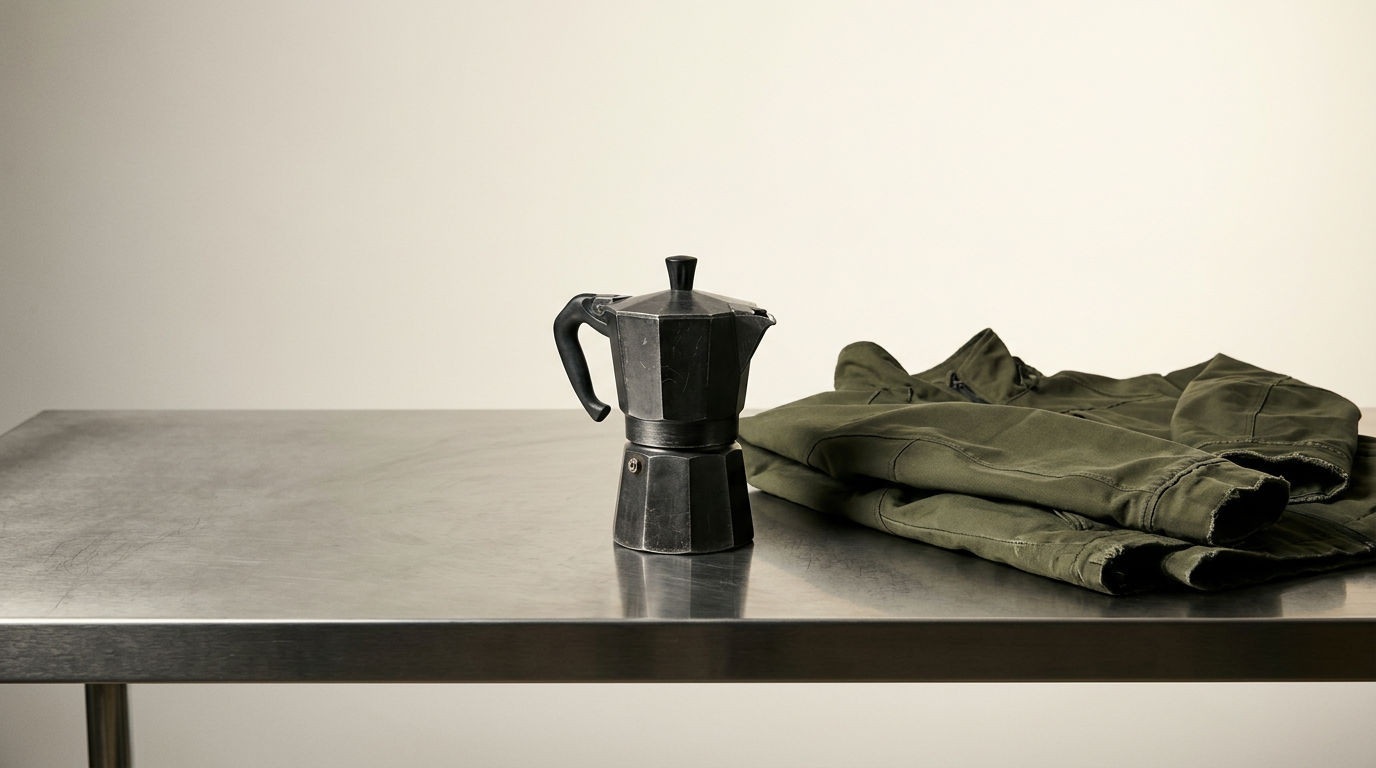
At Milan Design Week, two of Italy's most enduring design institutions unveiled a collaboration that speaks to a shared material philosophy. C.P. Company, the Bolognese outerwear label known for its garment-dyeing processes, and Alessi, the Piedmontese manufacturer of domestic objects, presented a joint project centered on the idea that a well-made object should age rather than deteriorate. The centerpiece is a limited-edition version of the 9090 espresso maker, finished in a black PVD coating engineered to develop a distinctive patina through daily use.
The 9090, originally designed by German industrial designer Richard Sapper in 1979, holds a particular place in Italian design history as the first espresso maker admitted to the permanent collection of the Museum of Modern Art in New York. Its selection as the foundation for this collaboration is not incidental. Sapper's design was conceived as a functional object with an industrial rigor that transcended its domestic context — a sensibility that aligns closely with C.P. Company's longstanding approach to outerwear, where military and workwear archetypes are refined through textile innovation.
Material Philosophy as Brand Identity
The conceptual bridge between the two brands rests on a specific idea: that surface transformation through use is not degradation but a form of personalization. C.P. Company has built much of its identity around garment-dyeing, a finishing technique in which completed garments — rather than raw fabrics — are dyed, producing subtle color variations and a hand-feel that shifts with repeated washing and wear. The application of PVD (physical vapor deposition) coating to the 9090 and an accompanying suite of steel objects operates on a parallel logic. PVD is a vacuum-based process commonly used in watchmaking and tool manufacturing to deposit thin, hard films onto metal surfaces. The matte black finish applied to the Alessi pieces is designed to wear unevenly over time, producing visual traces of handling and heat exposure.
Beyond the espresso maker, the collaboration extends to a moka set originally designed by French architect Jean Nouvel and a geometric tray by the late Italian designer Enzo Mari. Both objects carry the same matte PVD treatment, reframing familiar icons of Italian domestic life as technical artifacts — objects whose surfaces are expected to evolve rather than remain pristine. The gesture is deliberate: it positions kitchenware within the same conceptual framework that C.P. Company applies to nylon field jackets and goggle-lensed parkas, where evidence of use is treated as a feature rather than a flaw.
Sottsass, Memphis, and the Color of Industry
The apparel component of the collaboration draws from a specific chapter in Alessi's corporate history. In 1983, Ettore Sottsass — the Austrian-Italian architect and founder of the Memphis Group — designed a series of factory uniforms for Alessi's production facilities. The Memphis Group, active primarily between 1981 and 1988, challenged the austerity of mainstream modernist design with bold colors, geometric patterns, and deliberate references to pop culture and kitsch. Sottsass's uniforms for Alessi brought that sensibility into an industrial workplace, treating factory clothing as a legitimate design surface.
The capsule collection references this episode through nylon overshirts rendered in Deep Lavender and Malachite Green — palettes drawn directly from the Sottsass uniforms. The choice of nylon, a material central to C.P. Company's technical vocabulary, grounds the homage in the brand's own design language rather than producing a costume-like reproduction. The result is workwear-inflected clothing that carries a specific art-historical citation without announcing it loudly.
What makes the collaboration worth watching is less the individual products than the proposition underneath them. Both C.P. Company and Alessi have long operated in a space where function and aesthetics are not treated as competing priorities. The question the project raises — whether the design market's growing appetite for "living" materials represents a durable shift in consumer values or a passing narrative device — remains open. The answer may depend on whether buyers actually use the 9090 daily or place it on a shelf, which would be its own kind of verdict on the philosophy the collaboration claims to embody.
With reporting from Hypebeast.
Source · Hypebeast