The gaming mouse was once defined by its tether. For years, professional players and enthusiasts tolerated the friction of a braided cable to avoid the latency and battery anxieties of early wireless technology. Today, that trade-off has largely vanished. The current market for peripherals reflects a maturation of wireless protocols, where high-performance sensors and "tri-mode" connectivity have become the new baseline for the modern desk.
At the center of this shift are devices like the Logitech G305 LIGHTSPEED. By integrating the proprietary HERO sensor, Logitech prioritized power efficiency and precision in a chassis that eschews the aggressive, angular aesthetics of the last decade. It represents a move toward the mouse as a reliable, minimalist tool — one capable of competitive-grade performance without the visual noise of traditional gaming hardware. The design language is telling: muted colorways, symmetrical shells, and weight reduction as a feature rather than RGB lighting density. The peripheral, in other words, is being designed to disappear into the workflow rather than announce itself.
From Niche Accessory to Multi-Device Hub
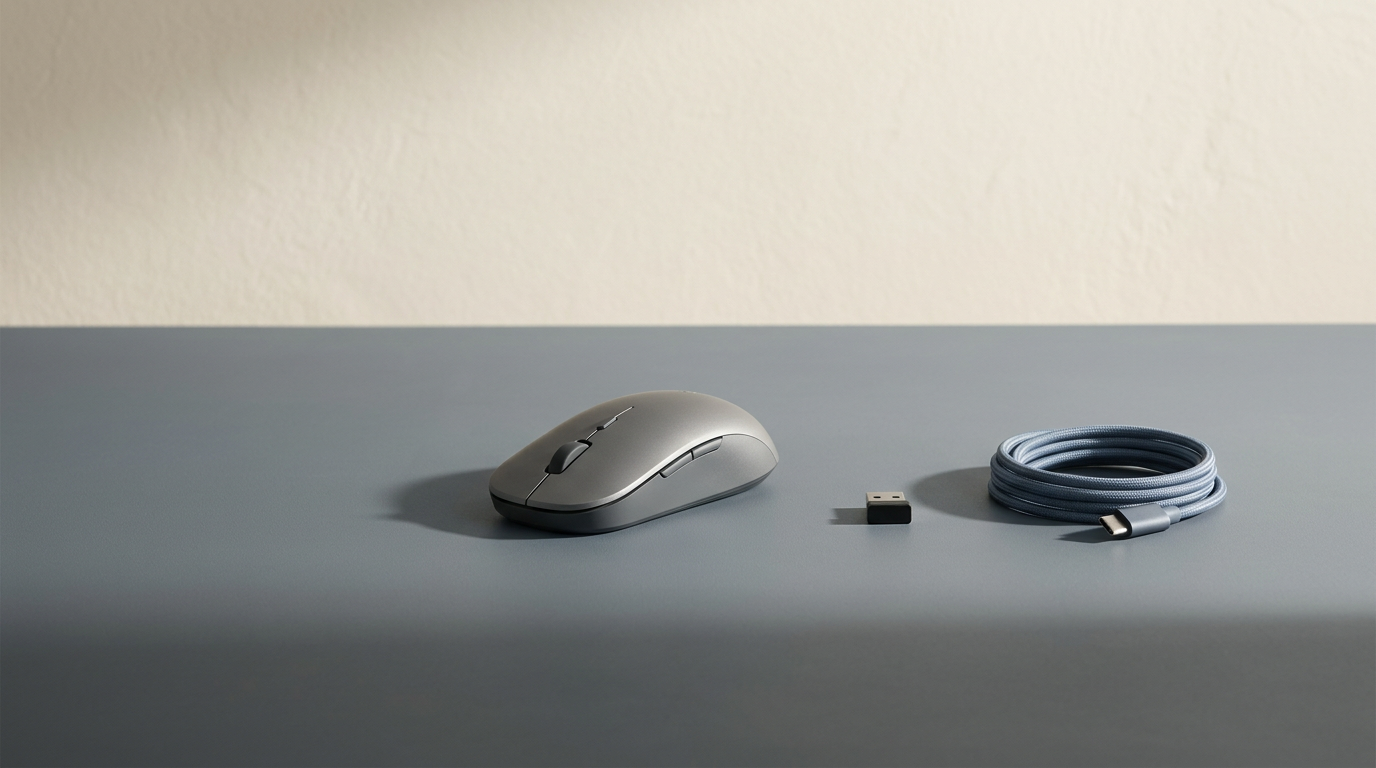
The more consequential development is not any single product but the emergence of "tri-mode" connectivity as a standard expectation. Tri-mode refers to a device's ability to connect via three channels — typically a low-latency 2.4GHz wireless dongle, Bluetooth, and a wired USB connection — and switch between them on the fly. Mice like the Havit MS966SE and the Attack Shark X11 are designed not just for a single gaming rig, but for a multi-device ecosystem, allowing users to toggle between a primary workstation, a laptop, and a tablet.
This is a meaningful architectural shift. For much of the peripheral industry's history, a mouse was paired to one machine. The assumption was a fixed desk, a single tower, a dedicated monitor. The proliferation of hybrid work, portable computing, and multi-screen setups has eroded that assumption. A tri-mode mouse acknowledges that the user's primary computing environment is no longer a single device but a constellation of them. The peripheral adapts to the person, not the other way around.
The pattern mirrors what happened in the keyboard segment several years earlier, when mechanical keyboards designed for gaming began appearing in offices and creative studios, stripped of their more theatrical elements. Gaming-grade switches and build quality found a broader audience once the form factor matured. The mouse market appears to be following the same trajectory: performance technology incubated in competitive gaming now migrating outward into general productivity use.
Industrial Design as Competitive Advantage
What distinguishes the current generation of wireless mice from their predecessors is not only the elimination of perceptible latency but a deliberate restraint in industrial design. The market is moving away from the sculpted, aggressive silhouettes that defined gaming peripherals through the 2010s. In their place: lighter shells, often below 80 grams, with neutral profiles that accommodate both claw and palm grip styles without committing to either.
This convergence of gaming and productivity aesthetics has strategic implications for manufacturers. Brands that once competed solely on DPI counts and polling rates now find themselves in a broader contest over ergonomics, material quality, and ecosystem integration. The competitive surface has expanded. A mouse that performs at tournament level but looks at home in a corporate meeting room addresses a larger addressable market than one that does only the former.
The question facing the peripheral industry is whether this convergence will commoditize the category or elevate it. As tri-mode connectivity, sub-one-millisecond wireless response, and lightweight construction become table stakes, the differentiators may shift toward software ecosystems, cross-device pairing intelligence, and long-term ergonomic research — areas where established players hold advantages but where smaller, more agile brands have shown a willingness to experiment. The cord is gone. What replaces it as the axis of competition remains unsettled.
With reporting from Olhar Digital.
Source · Olhar Digital