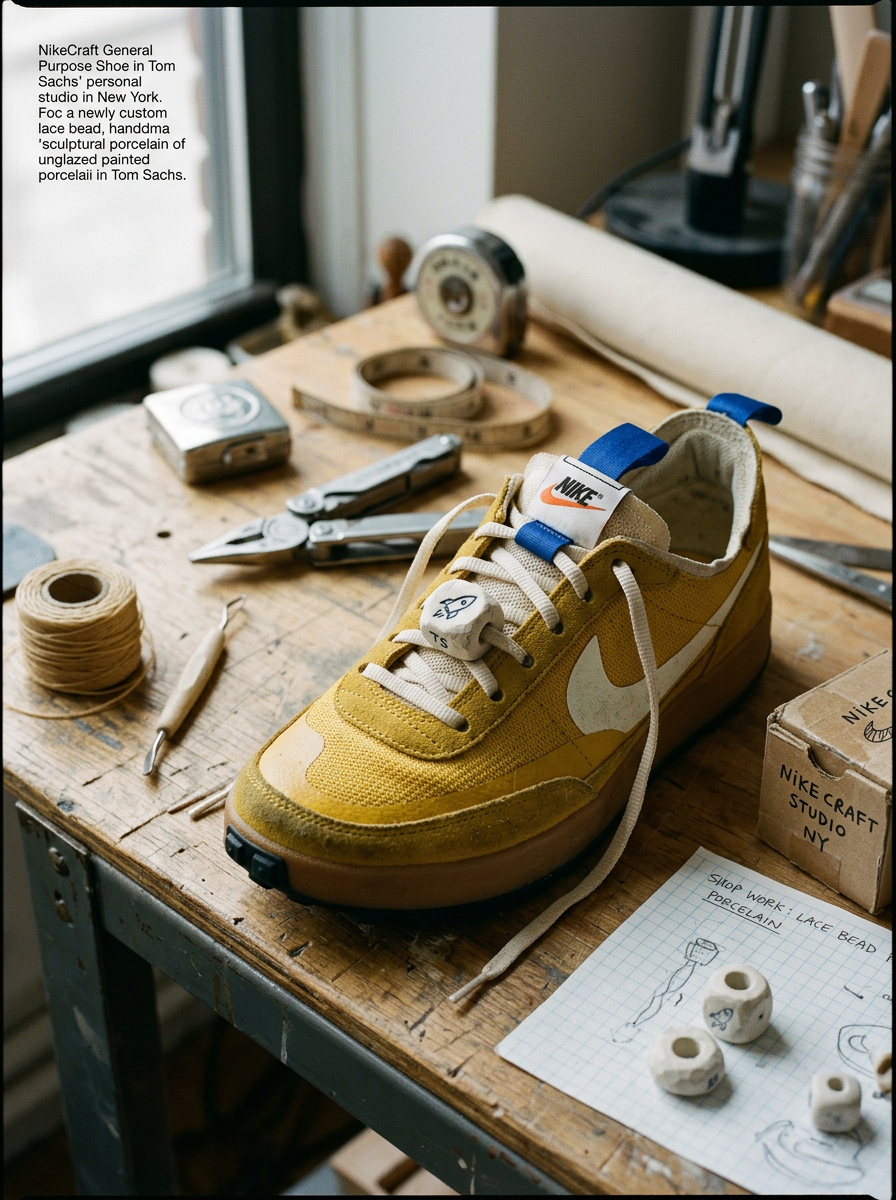
Tom Sachs and Nike's long-running NikeCraft collaboration has produced another object that sits deliberately at the boundary between fine art and consumer product. The I.S.R.U. Red Bead, a small porcelain accessory handmade in Sachs's New York City studio, is designed to thread onto the laces of the GPS Bricol — the latest iteration of the General Purpose Shoe. Priced at $19.99, it arrives bearing the artist's literal fingerprints, pressed into the ceramic surface before firing. It is, by any conventional measure, a shoelace bead. By Sachs's framing, it is a sculptural statement about craft, resourcefulness, and the value of the human hand in an age of automated production.
Ceramic beads are not new to Sachs's practice. They have appeared across his gallery work for years, attached to lamp pulls, AirPod trackers, and various studio objects. But this marks the first time a piece handmade in his studio has been formally integrated into a NikeCraft product — sold not through a gallery but through the commercial infrastructure of sneaker retail. The bead is also linked to the I.S.R.U. (International Space Resource Utilization) app, an educational curriculum Sachs developed to promote discipline and resourcefulness, extending the object's meaning beyond decoration into something closer to pedagogy.
Bricolage as brand philosophy
The French anthropologist Claude Lévi-Strauss popularized the concept of bricolage — the practice of constructing or repairing things from whatever materials happen to be available — as a mode of intellectual and creative problem-solving. Sachs has adopted the term as a guiding principle for much of his work, and the NikeCraft partnership has served as its most visible commercial expression. The General Purpose Shoe itself, first released in 2022, was designed to look unfinished, with exposed stitching and a utilitarian silhouette that rejected the aerodynamic sleekness typical of Nike's mainline offerings. The GPS Bricol, to which the Red Bead is meant to attach, extends that philosophy further, positioning imperfection and handwork as features rather than flaws.
This approach places the NikeCraft line in a distinct position within sneaker culture. Where most collaborations between artists and sportswear brands emphasize limited colorways, celebrity endorsement, or hype-driven scarcity, the Sachs partnership foregrounds process. The value proposition is not exclusivity for its own sake but a claim about authenticity — that a thumbprint in porcelain carries meaning that a machine-stamped logo does not. Whether consumers accept that proposition at scale is a separate question, but the framing is coherent with Sachs's broader body of work, which has long treated handmade imperfection as a form of honesty.
The accessory as art object — and what it signals
The Red Bead is positioned as the first in a planned series of ceramic accessories, which suggests NikeCraft intends to build an ecosystem of studio-made add-ons around its footwear. This model — selling small, relatively affordable art objects as functional accessories — has few direct precedents in the sneaker industry, though it echoes strategies in luxury fashion where branded charms, pins, and attachments serve as entry-point purchases that reinforce brand identity.
The deeper tension lies in what the bead represents about manufacturing and value. A porcelain object bearing an individual's fingerprints is, by definition, non-reproducible at industrial scale. Each bead carries slight variations — the depth of the impression, the glaze distribution, the minor asymmetries of hand-forming. In a market where sneaker authentication services exist precisely because counterfeits are visually indistinguishable from originals, an object whose authenticity is literally embedded in its surface makes a pointed argument. It suggests that the most reliable proof of origin is not a holographic tag or a blockchain certificate but the physical trace of the maker.
Whether this remains a niche gesture within a single collaboration or signals a broader shift in how footwear brands think about craft and provenance depends on factors beyond Sachs's studio — consumer appetite, production economics, and the willingness of a company the size of Nike to let handmade imperfection coexist with industrial efficiency. The bead is small. The question it raises is not.
With reporting from Hypebeast.
Source · Hypebeast