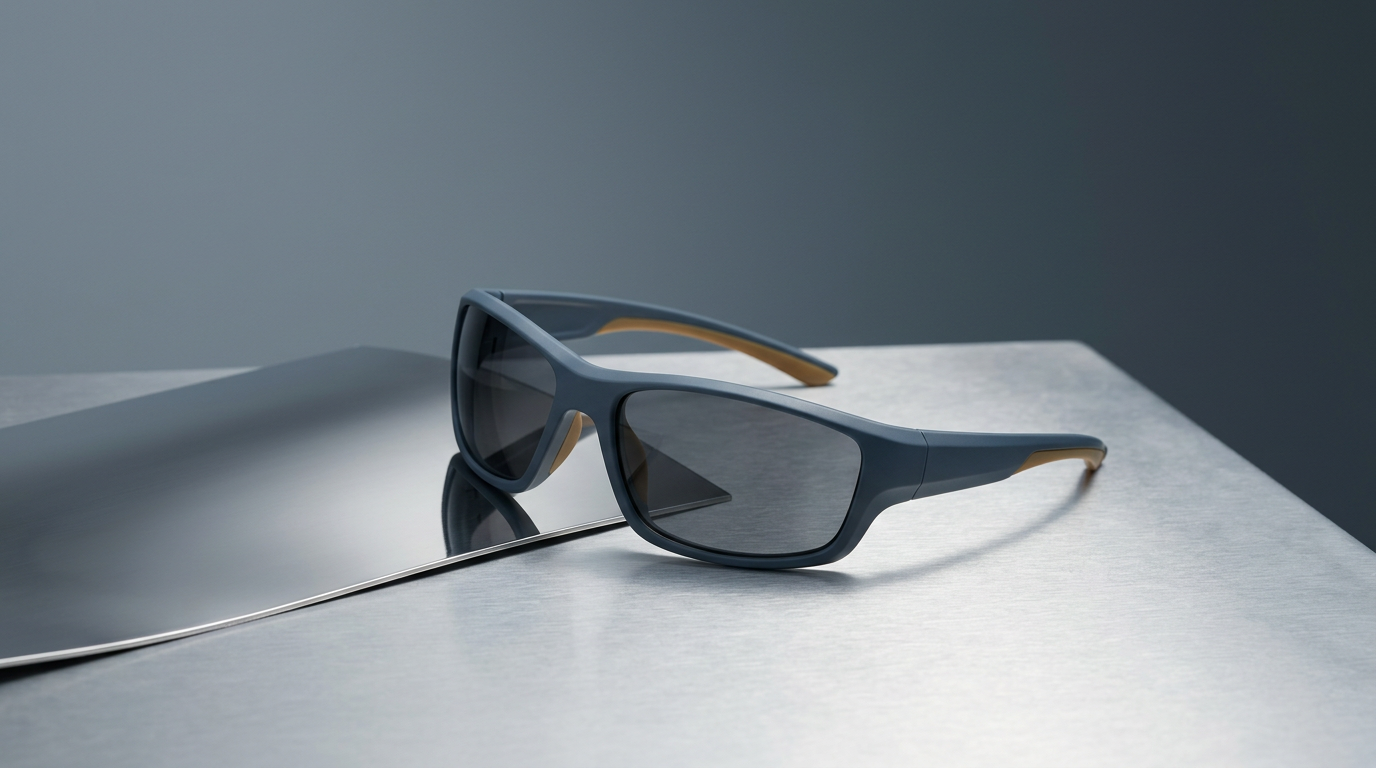
Warby Parker and the Problem of the Performance Wrap
The performance eyewear market has long operated under a tacit assumption: serious athletic sunglasses must look the part. Oversized shields, mirrored wraps, and aggressive geometries have dominated the category for decades, prioritized for wind protection and UV coverage at the expense of anything resembling everyday wearability. Warby Parker's new Sport collection, a line of frames starting at $195, represents a deliberate challenge to that assumption — an attempt to reconcile the technical demands of high-base-curve optics with the kind of understated design the company built its brand on.
The core engineering problem is well understood in the optical industry. A wrap-around frame hugs the face to provide a wide field of protection, but the curvature required to achieve that fit — measured in "base curve" — introduces progressive distortion toward the periphery of the lens. The steeper the curve, the worse the distortion. For prescription wearers, the problem compounds further. Warby Parker's approach relies on its in-house optical labs in Nevada and New York, where lenses are cut with the precision necessary to compensate for the optical penalties of a wrapped geometry. The goal: a frame that stays secure during movement without degrading visual clarity at the edges.
The Aesthetic Trap of Technical Gear
Performance eyewear occupies an unusual position in consumer culture. Unlike running shoes or cycling jerseys, which have gradually been absorbed into streetwear and casual fashion, sport sunglasses have largely resisted aesthetic crossover. The design language of brands that dominate the category — large logos, ventilated temples, neon accents — signals athletic intent so explicitly that wearing them off the trail or the bike can feel incongruous. This is not merely a style complaint; it is a market constraint. Consumers who want a single pair of sunglasses for both a weekend run and a weekday commute have historically been forced into compromise, choosing either technical reliability or visual restraint.
Warby Parker's bet is that this forced choice is increasingly unnecessary. The Sport collection uses lightweight Italian-made frames paired with specialized lens processing, aiming to deliver functional performance inside a silhouette that reads as classic rather than athletic. The strategy echoes a broader pattern in consumer goods: the migration of technical capability into everyday form factors. The same logic has driven the evolution of outdoor apparel, where brands have steadily moved away from garish colorways and toward designs that function equally well on a mountain and in an office.
Functional Invisibility as Market Strategy
Warby Parker's entry into performance eyewear also carries strategic implications. The company built its direct-to-consumer model around prescription glasses and everyday sunglasses — categories with relatively stable demand and high repeat-purchase rates. Sport eyewear introduces a different competitive landscape, one historically dominated by incumbents with deep roots in athletic sponsorship and retail distribution. Competing on pure performance credentials would be difficult for a newcomer. Competing on the intersection of performance and design, however, plays to Warby Parker's established strengths.
The broader question is whether the performance eyewear consumer is ready to prioritize discretion over display. Athletic gear has traditionally served a dual function: it performs, and it communicates. A pair of aggressive wraparound sunglasses tells the world something about the wearer's identity and intentions. Warby Parker's Sport line proposes a different value — what might be called functional invisibility, where the gear performs at a high level without broadcasting its purpose. Whether that proposition resonates depends on how much of the performance market is driven by genuine technical need and how much by the desire to look like someone with genuine technical need. The answer likely varies by segment, and the tension between those two impulses will shape how far a collection like this can travel.
With reporting from Fast Company.
Source · Fast Company