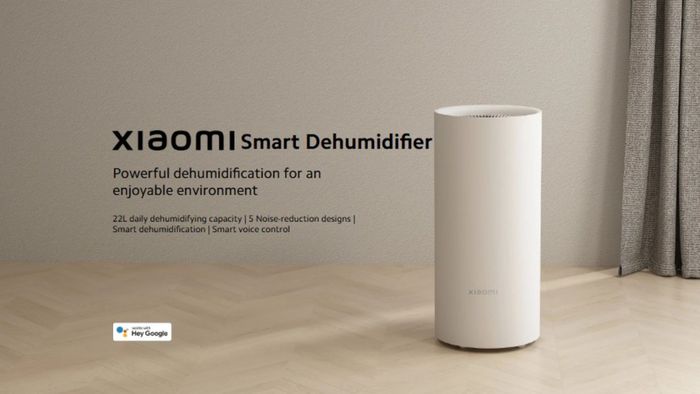
Xiaomi has listed a new high-capacity dehumidifier on its global product page, signaling an imminent wider release for a device built to manage humidity, mold, and stagnant air in residential environments. With a rated extraction capacity of 22 liters per day, the unit represents a step up from the company's earlier, more compact moisture-removal products and positions Xiaomi more squarely in the climate-control segment of the smart home market.
The device features a 4.5-liter internal reservoir, a dedicated mode for accelerating indoor laundry drying, and integration with Xiaomi's broader connected-home platform. An onboard humidity sensor automates operation based on ambient conditions, while a quieter "Sleep Mode" targets nighttime use in bedrooms and living areas. Continuous drainage via an external hose is also supported, removing the need for manual emptying during extended operation.
Humidity as a Design Problem
The product's feature set reads less like a consumer electronics pitch and more like a response to a structural reality of contemporary urban housing. In dense apartment blocks across East and Southeast Asia, Southern Europe, and Latin America, limited ventilation and compact floor plans create persistent moisture problems. Bathrooms without windows, interior laundry areas, and below-grade storage rooms accumulate humidity that, over time, promotes mold growth, degrades building materials, and affects respiratory health.
Dehumidifiers are not new technology. The refrigerant-cycle approach—drawing warm, moist air over cold coils to condense water vapor—has been a staple of HVAC engineering for decades. What has changed is the distribution model. Appliance incumbents like De'Longhi, Mitsubishi Electric, and Honeywell have long served this market through traditional retail and specialist channels. Xiaomi's approach differs: list the product within an existing digital ecosystem, price it competitively, and let the smart-home platform do the cross-selling. A consumer who already owns a Xiaomi air purifier or robot vacuum encounters the dehumidifier not as a standalone purchase but as another node in an integrated domestic network.
This bundling logic has strategic implications. Each additional device deepens a household's dependency on Xiaomi's app and connectivity layer, raising switching costs without requiring contractual lock-in. The dehumidifier, in that sense, is less a margin play on hardware and more an engagement play on platform stickiness.
From Convenience to Maintenance
Xiaomi's smart home catalog began with products that emphasized novelty and convenience—connected lightbulbs, cameras, air purifiers. The dehumidifier marks a subtle but meaningful shift in positioning. Moisture management is not aspirational; it is maintenance. Marketing a device as a safeguard against fungal growth and structural damage appeals to a different purchase motivation than a smart speaker or a connected display. It suggests Xiaomi sees opportunity in the less glamorous, more utilitarian layers of domestic infrastructure.
The broader home climate-control market has been moving in a similar direction. Air quality monitors, ventilation controllers, and humidity management devices have gained traction as consumers in post-pandemic environments pay closer attention to indoor environmental conditions. For Xiaomi, the question is whether utilitarian products carry the same viral appeal that drove adoption of its earlier lifestyle gadgets, or whether they require a different go-to-market approach—one built on education about health risks rather than feature demonstrations.
There is also the matter of geography. A 22-liter daily capacity is substantial, but dehumidification needs vary enormously by climate zone. A unit optimized for subtropical apartments in Shenzhen or São Paulo may be oversized for a flat in Berlin and undersized for a monsoon-season home in Mumbai. How Xiaomi calibrates regional availability and marketing against these differences will shape whether the product becomes a global catalog staple or a niche regional offering.
The tension, then, is between platform breadth and product-market fit. Xiaomi's ecosystem logic favors listing everything everywhere; the physics of humidity favor specificity. Which force prevails will say something not just about this dehumidifier, but about the limits of the one-platform-fits-all model in home hardware.
With reporting from Canaltech.
Source · Canaltech