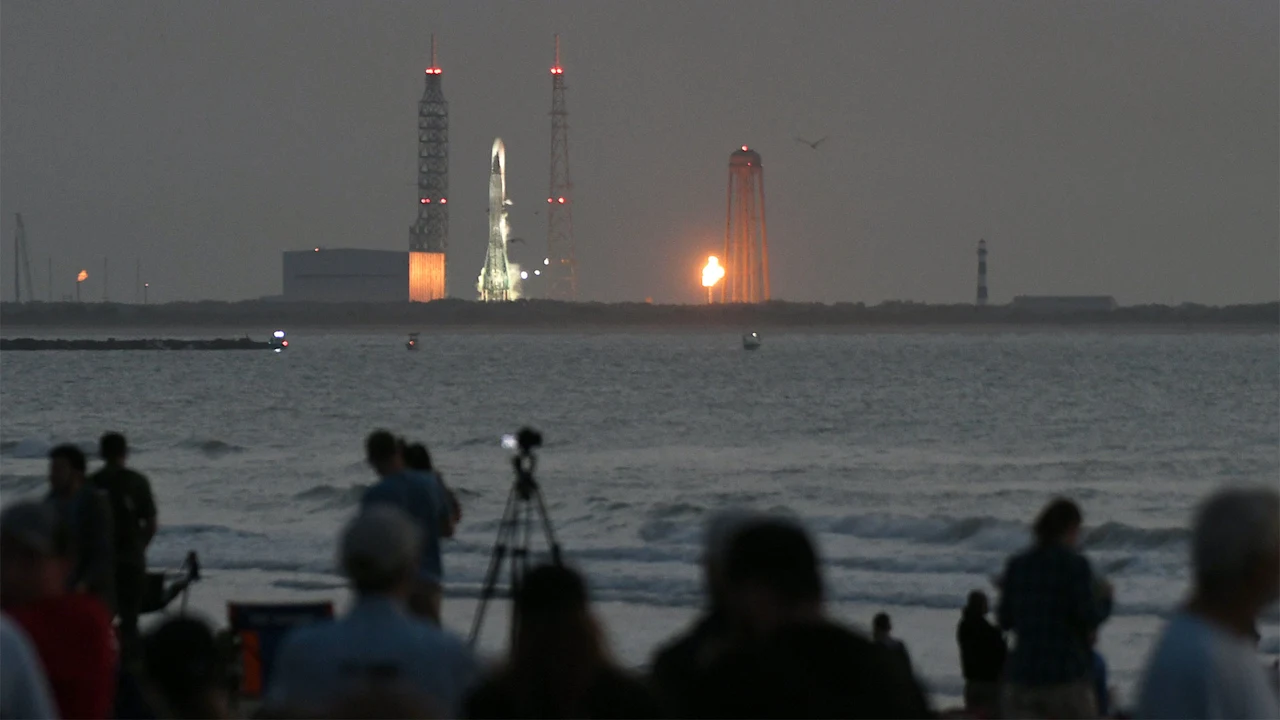
The choreography of modern spaceflight requires two distinct successes: the ascent and the delivery. On Sunday, Jeff Bezos's Blue Origin achieved the former but faltered on the latter during the third flight of its flagship New Glenn rocket. While the heavy-lift booster executed a successful launch and a controlled return to Earth, the mission's primary objective — the deployment of AST SpaceMobile's BlueBird 7 satellite — ended in a mishap that sent ripples through the nascent space-based internet sector.
For AST SpaceMobile, the stakes were high. The company aims to provide cellular broadband directly from space, a feat that requires a constellation of massive, unfolding satellites capable of connecting to standard mobile handsets on the ground. The failure of BlueBird 7 to properly deploy triggered a sharp sell-off in ASTS shares, as investors recalibrated the timeline for a functional orbital network. In the unforgiving environment of low-Earth orbit, a technical glitch during deployment can turn a multimillion-dollar asset into a silent piece of orbital debris.
The Fragility of a Business Model Built on Orbit
AST SpaceMobile occupies a distinctive niche in the satellite communications landscape. Unlike traditional satellite internet providers that require proprietary ground terminals, the company's architecture is designed to interface directly with existing smartphones — eliminating the need for specialized hardware on the consumer side. That ambition, however, demands satellites of unusual size and complexity, each carrying large phased-array antennas that must unfold precisely once in orbit. A deployment failure does not merely delay a schedule; it removes a node from a constellation whose commercial viability depends on reaching a minimum threshold of coverage.
The BlueBird satellite line represents the company's production-grade hardware, distinct from the earlier BlueWalker 3 test satellite that served as a technology demonstrator. Each unit lost or compromised forces a recalculation not only of capital expenditure but of the revenue timeline that public-market investors are pricing into the stock. The space-based direct-to-cell market is attracting growing interest — with competitors pursuing their own architectures — and any delay gives rivals additional runway to close the gap.
The sell-off in ASTS shares reflects a broader pattern familiar to investors in pre-revenue space companies: the distance between a compelling technology thesis and the engineering execution required to realize it remains vast, and single-event risk can move valuations dramatically.
Blue Origin's Reliability Question
The event also marks a sobering chapter for Blue Origin. The New Glenn rocket is the company's bid to compete directly with SpaceX's Falcon 9 and Falcon Heavy, offering a larger payload fairing and heavy-lift capacity designed to attract both government and commercial clients. The rocket's first flight ended in the loss of its upper stage. The second flight represented an improvement. But the third mission's failure to deliver its primary payload safely underscores a persistent gap between Blue Origin and its more established rival.
In the commercial launch market, reliability is compounding. SpaceX's Falcon 9 has amassed a flight cadence and success record that functions as a de facto industry benchmark, making it the default choice for operators who cannot afford to lose hardware. For Blue Origin to win contracts away from that incumbent, it must demonstrate not just occasional success but consistent, repeatable performance — the kind that insurance underwriters and satellite operators can model with confidence.
The booster's successful return to Earth is a genuine engineering achievement and a necessary step toward reusability economics. Yet the commercial launch business ultimately sells payload delivery, not booster landings. Customers pay for satellites in their correct orbits, functioning as intended. By that measure, the third New Glenn flight fell short.
The tension at the center of this episode is structural. The commercial space sector is entering a phase where demand for launch capacity is rising — driven by mega-constellations, national security payloads, and new entrants in Earth observation and communications. That demand should, in theory, support multiple launch providers. But the threshold for trust is high, and the penalty for failure is immediate: lost hardware, lost revenue, and, as AST SpaceMobile's stock price now reflects, lost investor confidence. Whether Blue Origin can compress its learning curve fast enough to capture meaningful market share before customers lock in long-term contracts elsewhere remains the central question for the company's commercial trajectory — and for every payload operator weighing where to place its next bet.
With reporting from Fast Company.
Source · Fast Company